
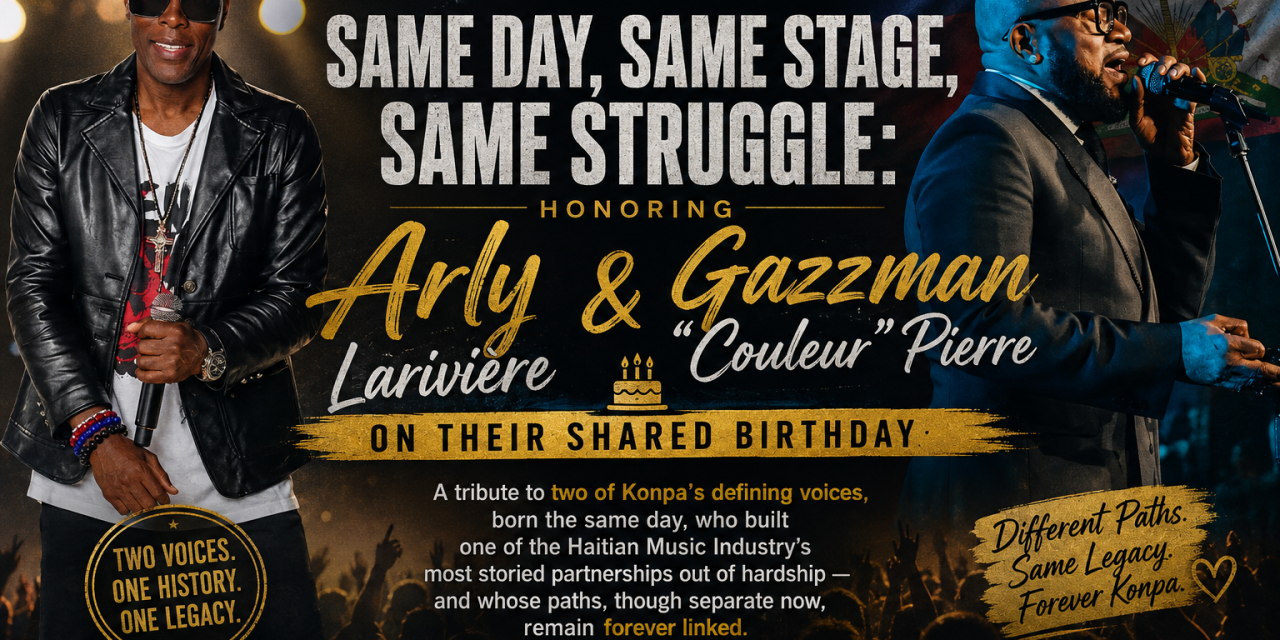
A tribute to two of Konpa’s defining voices, born the same day, who built one of the Haitian Music Industry’s most storied partnerships out of hardship — and whose paths, though separate now, remain forever linked.
There’s a small detail about Arly Larivière and Gazzman “Couleur” Pierre that feels almost too poetic to be true, and yet it is: both men were born on August 22 — Arly in 1972 in Cap-Haïtien, Gazzman in Gonaïves. Today, that shared birthday lands on the same date these two icons of Konpa first found each other, decades ago, in a Miami music scene hungry for something new. It’s the perfect occasion to look back at where they started, what they built together, and what it cost them to get there.
A note on the record: some details of this history circulate in slightly different forms across fan memory and press archives. This piece follows the timeline most consistently documented in Haitian music industry archives and corporate filings — worth setting straight, because the real story is dramatic enough without embellishment.
D’Zine: Where Two Futures First Crossed
Before either man became a household name, they were both simply young, hungry musicians trying to make it in Florida’s Haitian diaspora music scene. Gazzman had already logged time with Tah Pay in 1996 before, in 1997, joining forces with Arly Larivière and Francis Thelismond to co-found D’Zine — a band that would go on to record the well-remembered live album Millionnaire and the studio record Match rèd, home to the fan-favorite track “You and I.” Florida corporate records show the group formally incorporated as D. Zine Band, Inc. in February 1998, with both Arly and Gazzman listed among its officers alongside Thelismond, Wilson Jean, Luckner Bruno, and Jude Désir — a young band, on paper and in practice, building something together.
But D’Zine’s internal chemistry was combustible. By the summer of 2000, tensions inside the group had reached a breaking point, and on November 18, 2000, in front of a live crowd at Marc Arthur’s nightclub, Arly was abruptly and publicly removed from the stage — with Gazzman, by some accounts, among those announcing it. For Arly, it was a humiliating, career-shaking moment. For the Haitian Music Industry, it was about to become the origin story of something much bigger.
Nu Look: Turning Humiliation Into a Movement
Rather than let that moment define him, Arly turned it into fuel. Within months, he founded his own band — Nu Look — and, in a twist that speaks to the strange loyalty of musicians who understand each other better than anyone else, Gazzman joined him. The two men who had just been on opposite sides of D’Zine’s collapse combined forces to build something new, officially incorporating Nu Look Band, Inc. in Florida in July 2001, with Arly as president-director and Gazzman among the founding officers.
What followed was nothing short of transformative for Konpa music. With Arly as maestro, composer, and romantic lead vocalist, and Gazzman bringing his own fiery, high-energy stage presence, Nu Look introduced a smoother, more emotionally textured sound to the genre — Konpa Love, as it came to be known — built on Arly’s deeply personal songwriting (“Loving You,” “Notre Histoire,” “A Qui la Faute”) and the electric chemistry between the two frontmen. Albums like Big Mistake (2002), the live Arly Larivière Live with Nu-Look (2005), and Abò (2008) cemented the band’s place among the HMI’s elite, both in Haiti and across the diaspora.
For nine years, Arly and Gazzman carried that partnership — through the grind of constant touring, the pressure of an industry that never stops demanding the next hit, and the simple, exhausting reality of two strong creative personalities sharing one stage night after night. Anyone who has followed Konpa knows that kind of longevity, in a genre built on volatile band breakups, is itself an achievement worth honoring.
The Split — and Two Roads That Never Stopped Being Connected
By 2010, Gazzman was ready to build something of his own. He left Nu Look to launch diSIP de Gazzman Couleur, formally incorporated that February with the support of his longtime mentor Patrick Fabre. Under the diSIP banner, Gazzman would go on to release four albums — Mission (2010), VikTwa (2013), Klere Yo (2016), and Loreya (2019) — carving out his own modern, high-octane corner of Konpa and becoming, in the process, one of the rare Haitian artists to find major success fronting three different bands across his career: D’Zine, Nu Look, and diSIP.
Arly, for his part, kept Nu Look alive and evolving — first with singer Pipo for a two-year run, and eventually stepping forward as the band’s sole lead singer, backed by the musicians who had been with him for years. He formalized his solo business identity as Arly Larivière, Inc. in 2011, and continued composing and releasing new music — Confirmation (2011), I Got This (2013), My Time (2016), No Stress (2019) — proving that the songwriting instinct that carried Nu Look through its golden years hadn’t left with Gazzman. It had simply found a new chapter.
Why Today Matters
It would be easy to tell this story as a simple breakup narrative — two friends who built something great and then went their separate ways. But that misses what actually makes Arly and Gazzman’s story matter to the HMI: they were both cast out of the same room once, on the same humiliating night, and instead of disappearing, they built each other’s second act. Nu Look wasn’t just Arly’s revenge story — it was Gazzman’s too. And when it was finally time for Gazzman to build his own house with diSIP, he did it standing on a foundation the two of them had poured together, brick by brick, for nine hard years on the road.
That’s the part worth remembering today, on the one day of the year when both of their names are attached to the same date on the calendar. Whatever separated them as bandmates never fully separated them as figures whose histories are permanently intertwined — D’Zine, Nu Look, and everything that came after are, and will always be, chapters of the same story.
Happy Birthday to Arly Larivière and Gazzman “Couleur” Pierre — two men who turned a humiliating night in 2000 into two decades of Konpa history, who fought their way up together before finding the courage to build separately, and who remain, whether they’d put it this way or not, permanently bound to one of the greatest origin stories in the Haitian Music Industry.