
What the Government’s August 20, 2026 Expert Disclosure Reveals About the Case It Intends to Present at Trial
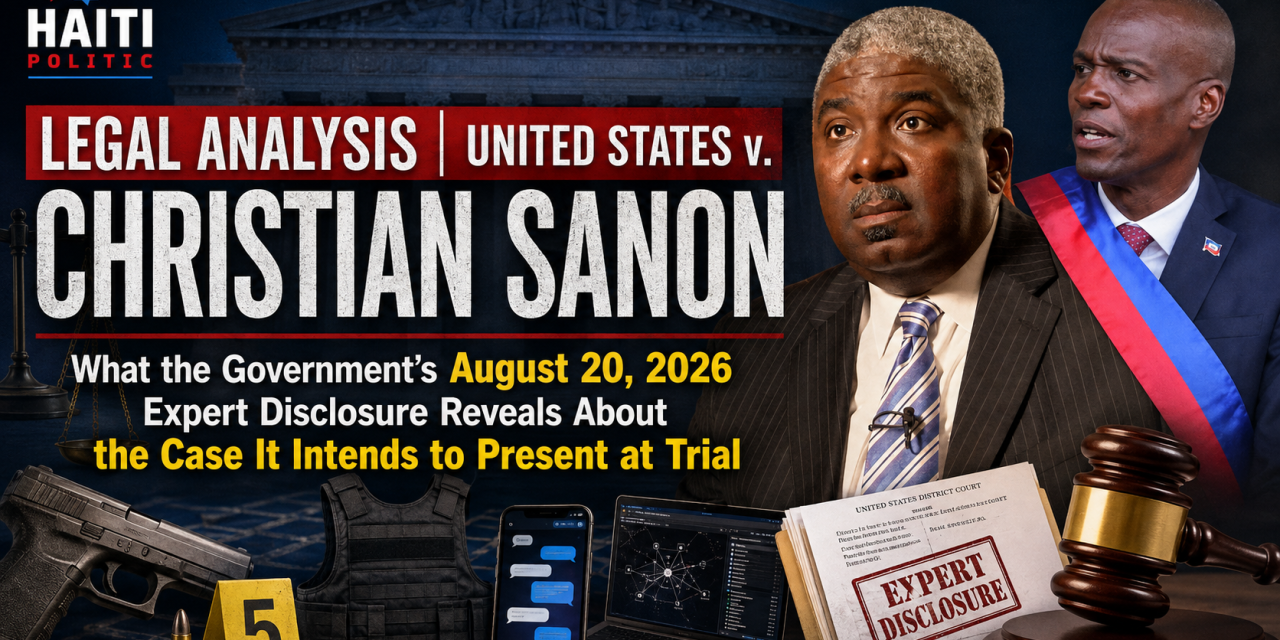
The 49-page filing titled “United States’ Updated Expert Disclosures and Demand for Defendant’s Reports of Examinations, Tests, and Expert Disclosures” is an important pretrial document in the federal prosecution of Christian Sanon. It was filed in the U.S. District Court for the Southern District of Florida in Case No. 22-20104-CR-BECERRA.
This filing is not a verdict, not a judicial finding that Sanon committed the charged crimes, and not itself proof of guilt. It is a disclosure by federal prosecutors identifying the expert testimony they expect to use during their case-in-chief, or potentially in rebuttal, and explaining the bases for those opinions under Federal Rule of Criminal Procedure 16.
Legally, however, the document is revealing because it shows the architecture of the prosecution’s trial strategy.
The government’s expert case appears to rest on four major evidentiary pillars:
firearms evidence, the autopsy of President Jovenel Moïse, U.S. export-control evidence concerning ballistic vests, and a very large body of digital forensic evidence extracted from phones and computers belonging to Sanon and numerous other individuals connected to the investigation.
1. WHAT IS THIS DOCUMENT ACTUALLY FOR?
Federal criminal procedure requires prosecutors to tell the defense about certain expert witnesses they intend to call, including the opinions those experts are expected to offer and the reasons supporting those opinions.
The government explains that it had already provided preliminary disclosures in May 2025 and that this filing is an updated disclosure. It also expressly reserves the ability to supplement the notice with additional experts, reports, testimony, or information.
The filing also serves another legal purpose.
After disclosing its experts, the government formally demands reciprocal disclosure from Sanon’s defense of examination or test reports and any defense expert testimony covered by Rule 16.
In practical terms:
The prosecution is showing Sanon’s lawyers the expert evidence it expects to place before the jury and is simultaneously demanding to know what expert evidence the defense intends to use against it.
2. THEODORE CHAVEZ: THE FIREARMS AND BALLISTICS EVIDENCE
The first named expert is Theodore Chavez, an FBI Laboratory forensic examiner specializing in firearm and toolmark identification, gunshot-residue distance determination, and shooting reconstruction. The government says he has examined firearms in hundreds of criminal cases and underwent extensive FBI competency training.
His testimony is designed to explain two related subjects.
Firearm operability
Chavez is expected to explain how the FBI determines whether a firearm functions, including examination of its safety mechanisms, firing modes, and any modifications. Firearms are inspected, test-fired, and evaluated in the condition in which they arrived at the laboratory.
Firearm identification
More significantly, Chavez will explain how forensic examiners compare bullets and cartridge cases to particular firearms.
The government’s description says examiners compare class characteristics—such as caliber, rifling, firing-pin shape, and extractor/ejector marks—and then microscopic individual characteristics caused by manufacturing and wear.
The filing identifies evidence designated GX 103C-1, GX 103D, and GX 104C-3 as samples Chavez examined.
The important limitation is this:
This disclosure does not reproduce Chavez’s ultimate case-specific conclusions.
Instead, the government says his official report had already been produced in discovery and contains the complete opinions it intends to elicit.
So from this filing alone, one should not claim that the FBI definitively matched a particular bullet to a particular gun unless that conclusion appears in the underlying report.
That report is not reproduced here.
3. THE AUTOPSY: DR. JEAN RC ARMEL DEMORCY
One of the most consequential portions of the filing concerns Haitian medical examiner Dr. Jean RC Armel Demorcy.
The government says Demorcy performed the autopsy of President Jovenel Moïse on July 10, 2021, at the request of Haiti’s Ministry of Justice. His French-language autopsy report and an English translation have already been produced and are expected to be introduced at trial.
According to the government’s disclosure, Demorcy will testify that:
Moïse suffered 12 gunshot wounds;
the body showed signs of asphyxia;
and
Moïse died as a result of the gunshot wounds.
The filing adds another important chain-of-evidence detail:
Demorcy says he removed four bullet fragments from the president’s body and delivered them to Haitian police.
That potentially connects the medical evidence directly to the firearms evidence.
In a trial presentation, prosecutors could use the autopsy expert to establish cause of death and wound evidence, followed by firearms testimony addressing physical ammunition evidence.
But again, this disclosure does not itself establish which defendant fired which weapon—or even that Sanon personally possessed or fired a weapon.
That distinction will matter enormously.
4. THE EXPORT-CONTROL CASE: BALLISTIC VESTS SENT TO HAITI
The government’s third major expert area may become particularly important to the federal charges.
Dimitri Smith, a Senior Engineer with the Munitions Control Division of the U.S. Department of Commerce’s Bureau of Industry and Security, is expected to testify about U.S. export laws.
His testimony concerns the Commerce Control List, Export Administration Regulations, and licensing requirements for controlled commodities.
The filing says ballistic vests—including soft and hard body armor—are controlled under specified Export Control Classification Numbers.
More importantly, Smith is expected to testify that the ballistic vests referenced in Counts 6 through 9 of the Fifth Superseding Indictment required a U.S. export license when exported to Haiti.
According to the filing, Haiti was then classified as a D:5 country, with restrictions connected to the U.N. arms embargo, and the relevant ballistic vests therefore required authorization.
The government says Smith will further explain that only a very narrow personal-use exception existed for certain U.S.-government-related travelers.
Then comes one of the filing’s most significant Sanon-specific assertions:
The government says Smith will testify that neither Christian Sanon nor Antonio Intriago applied for or received a Commerce Department license to export items from the United States to Haiti.
It adds that Intriago had previously applied for an export license in another context.
Legally, this testimony appears designed to help prosecutors establish an objective regulatory element of export-related offenses:
Was the item controlled? Was a license required? Did these defendants have one?
That is quite different from proving motive or proving participation in the assassination conspiracy.
It addresses the regulatory legality of the exports.
5. THE DIGITAL FORENSICS CASE MAY BE THE HEART OF THE PROSECUTION
The largest part of the filing is devoted to digital-forensics experts.
That fact alone is instructive.
The government appears prepared to authenticate, explain, and potentially introduce enormous quantities of electronic evidence recovered from phones and computers.
Experts identified include FBI and Homeland Security Investigations personnel such as:
Bryan Jordan, Elizabeth Riddell, Easton Schlueter, David Mingarelli, Ricardo Soto, Brian Hixson, Christopher Wallace, Timothy Stewart, Steven Towe, Richard Wilkins, Robert Herbster, Susy Hwang, Michael Betancourt, Sophak Thach, and Todd Ashley.
Their roles substantially overlap: explaining forensic extraction methods, authenticating extractions, and describing the recoverable contents of electronic devices.
6. THREE PHONES ASSOCIATED WITH CHRISTIAN SANON
The filing specifically identifies three Sanon devices:
L25 – Sanon Apple iPhone — 509-4330-0095
L26 – Sanon Apple iPhone — 561-644-9252
L27 – Sanon Motorola Stylus — 561-633-0034
These devices appear repeatedly in the forensic-expert sections.
FBI forensic examiner Bryan Jordan is also identified as having performed or assisted in extraction, processing or analysis involving those Sanon devices.
Several other forensic witnesses are similarly connected to those devices.
This is legally significant because digital evidence can potentially establish:
communications;
contacts;
locations;
photos and videos;
searches;
documents;
messages;
call records;
timestamps;
and potentially relationships among alleged participants.
However:
The disclosure does not reveal the substantive contents of Sanon’s messages.
It says the extraction data were previously provided to the defense during discovery, but the filing does not reproduce what Sanon actually said in those communications.
That distinction should not be overlooked.
The filing tells us which devices the government can authenticate and present.
It does not yet tell the public everything those devices contain.
7. THE GOVERNMENT HAS DIGITAL EVIDENCE FROM A LARGE NETWORK OF PEOPLE
The scope goes far beyond Sanon’s phones.
The filing identifies devices associated with numerous individuals, including:
James Solages;
Antonio Intriago;
Walter Veintemilla;
German Rivera-linked/Colombian personnel identified throughout the filing;
Joel John;
Bony Gregoire;
Jaar;
Ortiz;
Bergmann;
Handal;
Palacios;
Manich;
Balthazar;
and multiple Colombian individuals identified by surname.
The FBI and HSI experts are not merely expected to say, “We looked at a phone.”
They will explain the forensic methodology used to extract and preserve the data, potentially laying the evidentiary foundation necessary for prosecutors to introduce specific digital records at trial.
That may become crucial if prosecutors attempt to reconstruct:
who communicated with whom;
when plans changed;
what the mission was understood to be;
what was discussed before July 7, 2021;
and what participants did afterward.
But those substantive conclusions cannot be drawn from this disclosure alone.
The underlying messages and records matter.
8. WHY SO MANY DIGITAL-FORENSICS EXPERTS?
At first glance, the number of forensic examiners may seem unusual.
But the filing covers many devices obtained at different locations and times and apparently processed by different FBI and HSI personnel.
This means prosecutors may need several witnesses to establish chain of custody and forensic reliability.
The legal problem they are trying to avoid is straightforward.
A defense attorney could ask:
Who extracted this phone?
How do we know the data were not altered?
What software was used?
Was the phone unlocked?
Was the extraction complete?
Who preserved the image?
Who analyzed it?
Can the witness authenticate this message?
The government is positioning forensic witnesses capable of answering those questions.
9. WHAT THIS DOCUMENT TELLS US ABOUT THE GOVERNMENT’S TRIAL THEORY
Although the filing is formally about experts rather than an opening statement, the structure permits some careful inference.
The prosecution appears to be preparing a case that can combine:
THE DEATH
Dr. Demorcy establishes the medical cause of President Moïse’s death and physical wound evidence.
THE WEAPONS EVIDENCE
The FBI firearms examiner explains firearm operability, ammunition comparison, and toolmark examination.
THE LOGISTICS
The Commerce Department expert addresses whether ballistic protection equipment could lawfully have been shipped to Haiti and whether Sanon or Intriago possessed required export authorization.
THE COMMUNICATION NETWORK
The FBI and HSI digital experts provide the technical foundation for evidence extracted from the phones and computers of Sanon and numerous alleged participants.
Taken together, this is potentially powerful because federal conspiracy prosecutions often depend less on proving that one defendant physically committed every act and more on proving agreement, knowledge, participation, and acts undertaken to advance the alleged conspiracy.
But whether the government can prove those legal elements against Christian Sanon specifically will depend on evidence beyond the expert disclosure.
10. WHAT THIS FILING DOES NOT PROVE ABOUT SANON
This is the most important legal caution.
Nothing in this expert-disclosure document should be converted into a statement that:
Sanon personally shot President Moïse;
Sanon’s gun fired the recovered bullets;
Sanon personally exported a ballistic vest;
every message on his phones is incriminating;
or
the expert testimony will necessarily be admitted or accepted by the jury.
The document is the government’s description of testimony it intends to present.
Sanon remains entitled to contest:
expert qualifications;
scientific methodology;
relevance;
foundation;
chain of custody;
authentication;
interpretation;
scope of testimony;
and the government’s factual conclusions.
And the government itself acknowledges that some information may still be supplemented.
11. THE DEFENSE’S MOST IMPORTANT LEGAL BATTLEGROUNDS
Based only on this filing, several defense issues are likely to be significant.
A. Connecting Sanon personally to the evidence
The government may possess evidence proving that an assassination occurred and that multiple individuals participated.
That is not automatically the same as proving Sanon’s criminal intent.
The defense can force prosecutors to distinguish between:
association and agreement,
knowledge and intent,
political planning and murder planning,
presence in communications and participation in a criminal conspiracy.
That may become the central issue.
B. Digital evidence in context
A message can look dramatically different when isolated from the surrounding conversation.
The defense may therefore scrutinize:
timestamps;
deleted messages;
translations;
metadata;
missing portions of chats;
speaker identification;
device ownership;
and whether prosecutors are presenting complete conversational context.
C. Firearms limitations
Chavez’s section expressly acknowledges that firearm-pattern examinations have limitations and that he will explain permissible conclusions under FBI and DOJ standards.
That language matters.
Firearms identification is expert opinion based on comparative examination; defense counsel may test how confidently the examiner can attribute a questioned bullet or casing to a particular firearm.
D. Chain of custody from Haiti
The four fragments removed during Moïse’s autopsy were reportedly turned over to Haitian police.
If those fragments later became evidence tested by U.S. authorities, the defense may examine every step between:
the body → medical examiner → Haitian police → subsequent custodians → FBI laboratory.
Any significant unexplained break could become a litigation issue.
The document itself does not supply that full chain.
E. Export violation versus assassination intent
Even if prosecutors prove that ballistic vests were exported without the required license, the defense can still argue that an export violation does not by itself establish participation in a murder conspiracy.
The government will presumably attempt to place the body armor in a larger factual context.
The defense will attempt to prevent the jury from treating one legal violation as automatic proof of another.
12. AN IMPORTANT PROCEDURAL DETAIL: THE ORTIZ TRIAL
Many of the experts listed here state that they previously testified in United States v. Ortiz et al., Case No. 22-20104-CR-BECERRA, in 2026. For example, Chavez, Demorcy and numerous digital experts list that proceeding among their recent testimony.
That suggests much of the scientific and digital evidentiary machinery has already been used in a related trial arising from the same broader federal case.
From a defense perspective, that is valuable.
Sanon’s lawyers may have access to prior transcripts showing:
what each expert previously testified;
how the witness performed under cross-examination;
whether the witness made concessions;
and whether the testimony expected against Sanon differs from testimony previously presented.
That can be extremely useful for impeachment and preparation.
13. ONE UNUSUAL POINT IN THE DOCUMENT
The expert sections jump from:
IX. Brian Hixson
to
XI. Christopher Wallace
and later continue XII through XX.
So Section X does not appear in the parsed filing before Section XI begins.
That may simply be a numbering/editing issue rather than anything substantive. Nothing in the document itself explains it, so it would be inappropriate to infer more.
14. THE GOVERNMENT IS STILL RESERVING FLEXIBILITY
Another point that should not be missed:
This isn’t necessarily the final expert lineup.
The prosecution expressly reserves its right to:
add experts;
add testimony;
provide additional reports;
and
supplement the information concerning already disclosed witnesses.
For some later witnesses, the disclosure itself says additional qualifications or information will be provided later.
For example, the government says it will provide additional information regarding FBI Special Agent Sophak Thach’s qualifications, prior expert testimony and publications upon receipt.
The government similarly indicates that additional information concerning Todd Ashley will be supplied.
That could potentially generate later defense objections if supplementation occurs too close to trial or materially alters the expected testimony.
15. THE BOTTOM LINE
This filing does not reveal the entire government’s case against Christian Sanon.
But it provides a remarkably clear map of the scientific and technical evidence prosecutors intend to place around that case.
The United States is preparing to tell the jury a story supported by:
a medical examiner explaining exactly how Jovenel Moïse died;
an FBI firearms specialist explaining the physical firearms evidence;
a Commerce Department expert explaining why ballistic armor allegedly involved in the operation required U.S. export authorization;
and
a substantial team of FBI and HSI forensic specialists authenticating an extensive network of phones, computers, communications and other digital evidence.
The government also intends to establish specifically that, according to Commerce Department records, Christian Sanon did not apply for or receive the export license prosecutors say was necessary for the relevant controlled items.
And the government’s forensic evidence expressly includes three phones attributed to Sanon.
But the central trial question remains unanswered by this document:
WHAT DOES THE EVIDENCE PROVE CHRISTIAN SANON KNEW, INTENDED, AGREED TO, AND PERSONALLY DID?
That is where the criminal case ultimately turns.
It is possible to prove that President Moïse was assassinated.
It is possible to prove that weapons or body armor moved through particular channels.
It is possible to authenticate thousands of digital communications.
But federal prosecutors still have to connect those facts to the specific elements of the crimes charged against this particular defendant beyond a reasonable doubt.
That is the difference between an investigation and a conviction.
And it is why this 49-page disclosure is important:
It tells us what scientific tools the government plans to use—but not yet whether those tools establish Sanon’s criminal responsibility.
The filing was electronically filed on August 20, 2026, by the U.S. Attorney’s Office through Assistant U.S. Attorneys Sean T. McLaughlin, Jason Wu and Altanese Phenelus.
This is a legal analysis of the uploaded court filing, not legal representation or a prediction of the verdict.