
A legal explainer for HMI Music
The Case: What the Court Record Shows
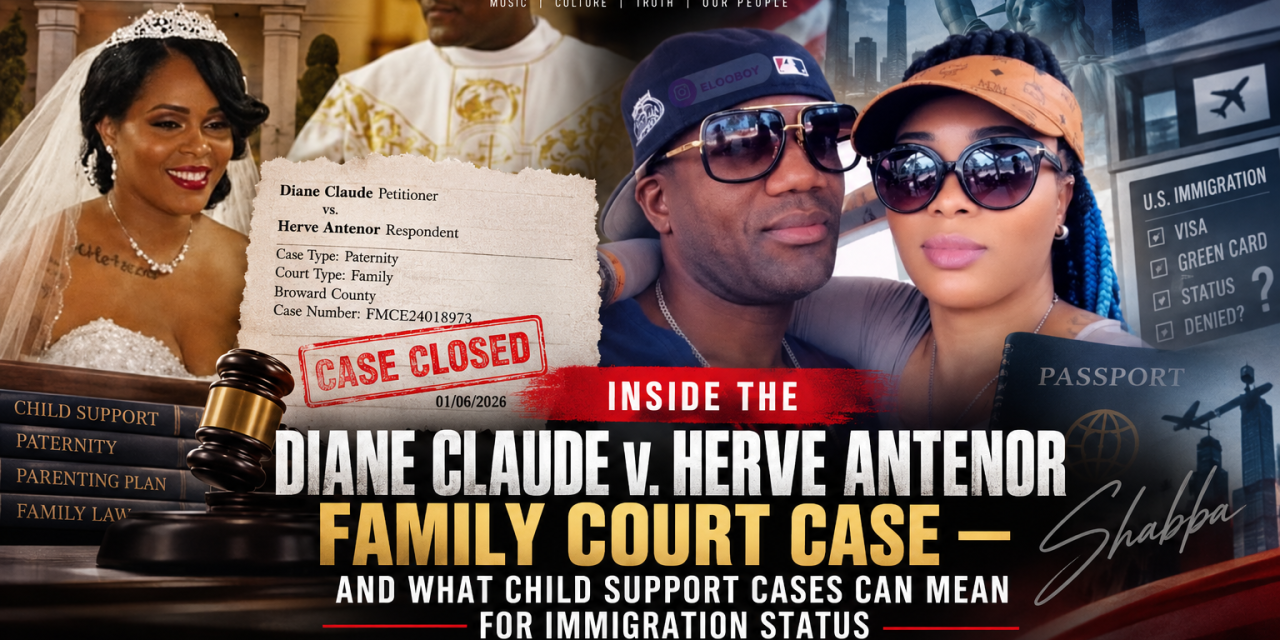
Diane Claude and Herve Antenor were married in 2016 and divorced in Haiti in 2021, with the divorce finalized and registered with Haiti’s National Archives in early 2022. The couple has two minor children together, born in 2011 and 2014.
Public Broward County Clerk of Courts records show three cases between the two parties in the 17th Judicial Circuit:
- DVCE22-001998 — a stalking/violence injunction case filed March 2022, closed.
- FMCE22-004060 — the couple’s Florida dissolution-of-marriage case (filed March 2022), listed as a related case.
- FMCE24-018973 — a paternity and child support action, the focus of this piece.
In October 2024, Claude filed a Verified Petition to Determine Paternity, Parenting Plan, Time-Sharing, Child Support, and for Related and Other Relief. The petition explained that the couple’s Haitian divorce judgment had not addressed custody, time-sharing, or child support for their two children, so Claude asked the Florida court to establish those terms. She requested sole parental responsibility, a 50/50 time-sharing arrangement, and a child support determination under Florida Statute 61.13.
Antenor, through counsel, filed an answer and appeared in the case in November 2024. The case proceeded through typical family-law steps over the following year — a proposed parenting plan, financial affidavits, mediation notices, and case management conferences — before Claude filed a Notice of Voluntary Dismissal Without Prejudice on January 6, 2026, closing the case.
A dismissal “without prejudice” is a procedural closure, not a ruling on the merits. It means Claude chose to end the case herself, and it does not reflect any finding by the court that Antenor owes support, failed to pay support, or did anything wrong. It also means Claude retains the right to refile the same claims later. Nothing in the public record indicates why the case was dismissed, and nothing in these filings references immigration proceedings, a USCIS petition, or any deportation action involving either party.
Does a Child Support Case Affect Immigration Status? The General Legal Framework
Readers sometimes ask whether a child support dispute can affect someone’s immigration case. The honest answer is: it depends on the type of immigration benefit at issue, and the connection is usually indirect. Here’s how it generally works under U.S. immigration law — again, as a matter of general legal principle, not as a claim about this specific case.
1. The Affidavit of Support (Form I-864)
In family-based green card cases, a U.S. citizen or permanent resident sponsor must file Form I-864, promising to financially support the immigrating relative at 125% of the federal poverty line. USCIS can scrutinize a sponsor’s finances closely, and existing child support obligations count as a financial liability that can undermine a sponsor’s ability to meet that threshold. If a petitioner already owes substantial support to other children, it can weaken — though not automatically doom — the sponsorship.
2. “Good Moral Character” in Naturalization Cases
For someone applying to become a U.S. citizen, USCIS evaluates “good moral character” over a statutory period (usually 3–5 years). Under 8 CFR § 316.10, willful failure to support dependents is one of the factors that can be weighed negatively — though it typically requires a documented pattern of non-payment, not merely the existence of an open support case.
3. Public Charge and Benefits Considerations
If child support obligations lead someone to rely on public benefits, or if a support order results in wage garnishment that affects a sponsor’s demonstrated income, that can factor into public-charge-related determinations in adjustment-of-status cases.
4. Removal Proceedings Are a Separate Track
It’s important to be precise here: an open or even resolved family court case, by itself, is not a basis for removal (deportation). Removal proceedings arise from immigration violations — unlawful presence, certain criminal convictions, visa fraud, failure to maintain status, and similar grounds defined in the Immigration and Nationality Act. A domestic case like a paternity/support action does not directly trigger deportation. Where family court and immigration outcomes intersect, it is almost always through one of the indirect channels above (sponsorship viability, good moral character, or a related criminal matter), not a direct legal pipeline from “child support case” to “deportation.”
5. Voluntary Departure vs. “Self-Deportation”
Separately, the record here shows no immigration filing at all — so any claim that a specific person “had to self-deport” because of this case would be speculation not supported by the documents. People sometimes choose to leave the U.S. voluntarily for many reasons unrelated to court proceedings, and conflating a closed civil family law matter with an immigration departure requires actual evidence connecting the two.
Bottom Line
The Claude v. Antenor paternity case followed a fairly ordinary Florida family court trajectory and ended in a voluntary dismissal — a neutral outcome that doesn’t establish wrongdoing by either party. Separately, it is true that child support obligations can complicate certain immigration processes, particularly family-based sponsorship and naturalization applications, through specific, documented legal mechanisms. But drawing a direct line from this particular case to an immigration consequence for either party isn’t supported by anything in the public record, and readers should treat any such claim with skepticism absent actual immigration filings or court findings to back it up.
This article is for general informational purposes and does not constitute legal advice. Individuals with questions about how a family court matter may affect an immigration case should consult a licensed immigration attorney.