

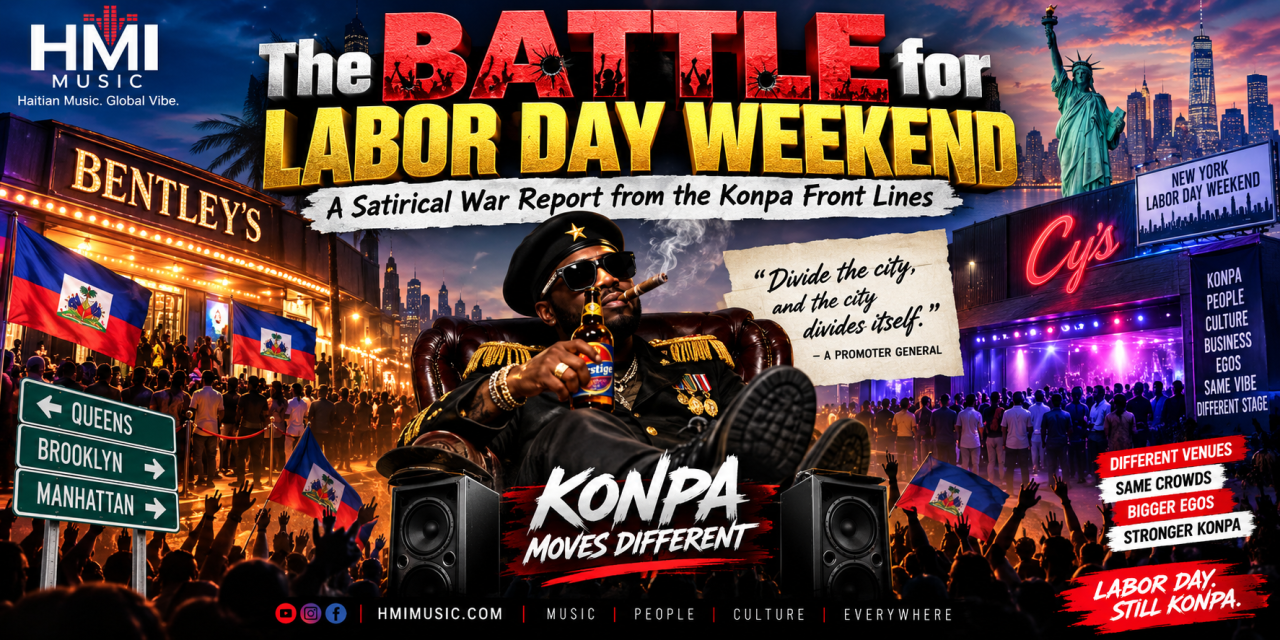
NEW YORK — Somewhere between the flags draped over Bentley’s marquee and the smoke machines warming up at Cy’s, a general who has never worn a uniform sat back, sipped his Prestige, and whispered the oldest line in the promoter’s playbook: “Divide the city, and the city divides itself.”
Sunday, September 6th, 2026, wasn’t just Labor Day weekend in New York. In the world of Haitian music — a scene where loyalty runs as deep as any rivalry in sports — it was, allegedly, a night of maneuvering. Three fronts. One dance floor’s worth of partygoers to fight over. And, if the group chats are to be believed (they should not be, but let’s have fun anyway), a classic two-point choke.
Reading the Battle Map
For the uninitiated: a two-point choke is a military term for holding two chokepoints to control how a larger force can move. Translated to konpa logistics, our imagined war room might have drawn it up like this:
- The North Front — Cy’s Restaurant & Lounge, Nyack: K-Dilak x Bedjine, backed by BME and Fanfan Bonbagay, holding it down at 37 NY-59, doors at 10PM, $50 in advance.
- The West Front — Bentley’s, Brooklyn: T-Vice, Vayb, and P-Dous, dropping into the East Flatbush/Flatlands corridor, early bird tickets at $60.
- Caught in the middle — Amazura, Jamaica, Queens: Zile, Klass, and KAI, in a room that can swallow up to 4,000 people, needing every one of those seats filled to call it a win.
And here’s where the (fictional, satirical) plot thickens for the true students of konpa history: Klass has long been cast as a rival to both K-Dilak x Bedjine’s camp and to T-Vice in the mythology of the genre’s never-ending “which band is really #1” debates that fuel Haitian radio call-in shows and Facebook comment sections to this day. K-Dilak x Bedjine, meanwhile, are frequently painted by fans as challengers to that same Zile/Klass axis. So when three of these camps end up booked the same night, same city, the internet doesn’t need much encouragement to start drawing tactical maps.
The Imagined Pincer Move
In our satirical retelling, the “strategy” goes like this: put one show 35 miles north in Nyack and another show west in Brooklyn, and you’ve theoretically built two magnets pulling from opposite edges of the diaspora’s geography — leaving the middle target, Amazura in Queens, to fend for itself against the FOMO of two other flyers blowing up everybody’s timeline at the same time.
Did anyone actually sit in a boardroom and plan this? Almost certainly not — promoters book venues based on availability, artist routing, and, frankly, whichever Sunday in September has the word “Labor Day Madness” still available as a title. But it makes for a much better story to imagine Bentley’s and Cy’s as pincers closing in on Amazura’s west flank, doesn’t it?
The Real Battle Isn’t Geography — It’s Saturation
Strip away the satire and there’s a real, well-worn phenomenon underneath the joke: Haitian Labor Day weekend in the New York area is chronically oversaturated with major shows. Every promoter wants the holiday Sunday. Every band wants the marquee date. And every year, fans end up doing exactly what our fictional generals are “counting on” — picking one flyer and letting the other two live only in screenshots of “wish I could clone myself” comments.
Whether Amazura’s room was packed, half-full, or somewhere in between that Sunday isn’t something this piece can verify, and we’re not going to pretend otherwise. What we can say, without any satire attached, is that the scene’s real challenge isn’t rival bands plotting chokepoints — it’s an industry that keeps scheduling its biggest nights directly on top of each other and asking fans to be in three places at once.
Until someone in the diaspora’s promotion circles calls a ceasefire on Labor Day date-stacking, expect the group chats to keep drawing battle maps — even if the only real casualty is everybody’s gas money driving between boroughs trying to catch all three.
Again: the “strategy,” “chokepoint,” and attendance details above are satire, written for entertainment. No claim is made that any promoter, band, or venue engaged in coordinated scheduling against a competitor, or that any specific show had low or high attendance.