

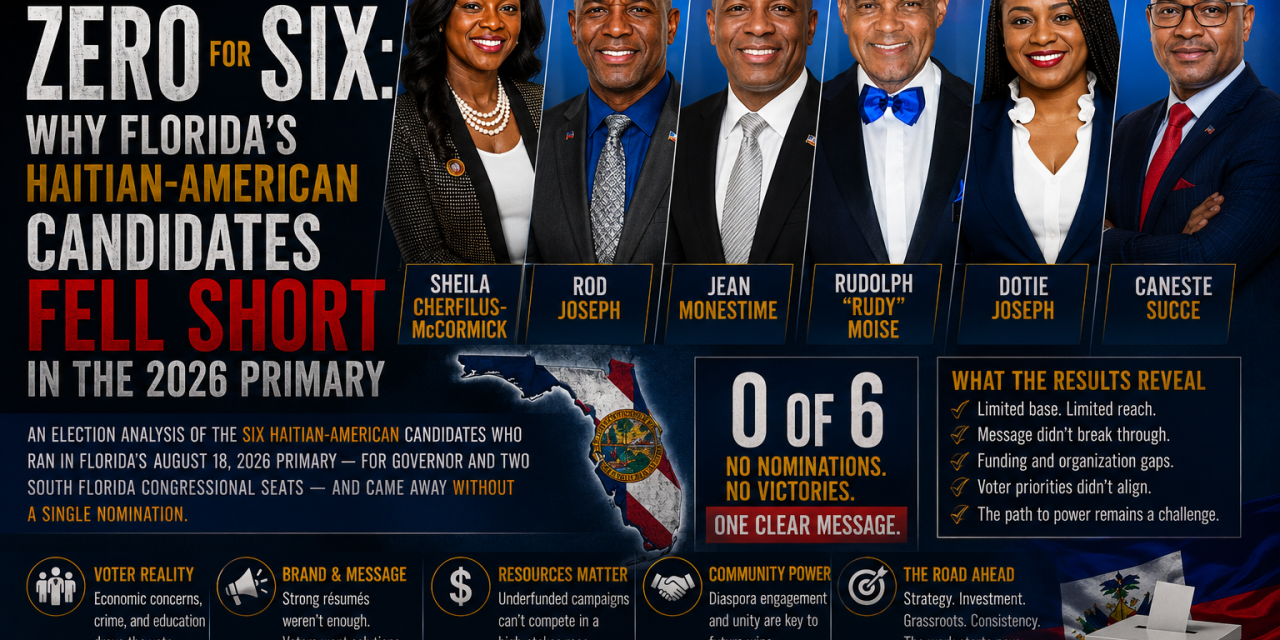
An election analysis of the six Haitian-American candidates who ran in Florida’s August 18, 2026 primary — for Governor and two South Florida congressional seats — and came away without a single nomination.
Florida’s August 18, 2026 primary was billed, in some corners of the Haitian diaspora press, as a potential landmark night: six Haitian-American candidates on the ballot at once, spanning a gubernatorial race and two of South Florida’s most competitive, Haitian-heavy congressional districts. When the votes were counted, the result was a clean sweep in the wrong direction — 0 for 6. Understanding why requires looking at each race on its own terms, because the six candidates weren’t beaten by the same opponent or even the same dynamic. They lost to redistricting, to name recognition, to fractured fields, and in one case, to a still-unresolved federal indictment.
District 20: A Historically Black Seat Redrawn Out From Under Its Incumbent
Sheila Cherfilus-McCormick (Democrat) entered the primary as the most nationally known of the six, and also the most compromised. She had represented District 20 since winning a 2022 special election following the death of longtime Congressman Alcee Hastings, but she resigned in April 2026, shortly before the House Ethics Committee was set to act on findings that she had committed more than two dozen violations tied to her office and campaign financing — including allegations that she funneled a multi-million-dollar disaster-relief overpayment into her campaign accounts. She was subsequently indicted by federal prosecutors and faces trial. She has denied wrongdoing throughout and characterized the investigation as politically motivated. Running for her old seat anyway, she found herself in a five-way Democratic primary dominated instead by the district’s newest arrival: veteran Congresswoman Debbie Wasserman Schultz, whose own seat had been eliminated by Republican-led redistricting and who parachuted into District 20 on the strength of over a decade in Congress, deep fundraising networks (more than $3 million raised), and institutional support. Wasserman Schultz won with just under half the vote in a fractured field that also included former Broward Mayor Dale Holness, activist-teacher Elijah Manley, and rapper Luther “Uncle Luke” Campbell. For Cherfilus-McCormick, the loss reflects two compounding problems: an ethics cloud that made her a harder sell to donors and voters even sympathetic to her account, and a district boundary that no longer favored an incumbent-turned-challenger facing a better-funded, better-known rival.
Rod Joseph (Republican), a Haitian immigrant, U.S. Army combat veteran and Purple Heart recipient, ran for the Republican nomination in the same district — a longshot bid in a historically Democratic seat by design, since District 20 has been represented by Black Democratic lawmakers for over three decades. Joseph, who holds degrees from Ashford University and Hawaii Pacific University and had previously run unsuccessfully for U.S. Senate in Florida in 2024, built his campaign around his military service, faith-based outreach, and a message aimed at frustrated former Democrats. He raised a modest sum — roughly $21,000 — nowhere near enough to compete with eventual nominee Brent Andersen in a four-way Republican field that also included Navy veteran Carla Spalding and Lateresa “LA” Jones. Underfunded campaigns in low-turnout primaries rarely close the gap on name recognition, and Joseph’s did not.
District 24: Splitting the Vote in a Seven-Way Scramble
Jean Monestime (Democrat), finishing with roughly 6.09% of the vote, brought arguably the deepest resume in local government of any Haitian-American candidate on the ballot statewide. He served as a Miami-Dade County Commissioner from 2010 to 2022, including two years as commission chairman — becoming the first Haitian-American to hold either position. Yet name recognition built over a decade in county government did not translate into a competitive congressional bid. District 24, an open seat vacated by retiring Congresswoman Frederica Wilson, drew a crowded seven-candidate Democratic field, and polling throughout the summer consistently showed the race narrowing to three frontrunners — state Senator Shevrin Jones, Miami-Dade Commissioner Oliver Gilbert, and former Congressman Kendrick Meek — none of whom was Monestime. Gilbert ultimately won by roughly two points over Jones after securing Wilson’s own endorsement, a decisive advantage in a district she had represented since 2011. Monestime’s campaign simply never broke into that top tier; in a seven-way race with limited debate stage time and media attention concentrated on the leaders, a credible but lower-profile candidate can post a respectable vote share without ever being competitive.
Rudolph “Rudy” Moise (Democrat) actually led the Democratic field in fundraising for a stretch of the race — reporting more than $650,000 in total receipts — but still finished with only about 7.95% of the vote. Moise’s background was, on paper, formidable: born in Port-au-Prince, he moved to Chicago at 17, earned a doctorate in osteopathic medicine, then a JD and MBA from the University of Miami, and served over two decades as a flight surgeon in the U.S. Air Force, retiring as a colonel — reportedly the highest rank held by a Haitian-American in the Air Force at that time. He also served as Haiti’s ambassador-at-large for investment in 2014. But money and biography weren’t enough to overcome the structural realities of the race: Gilbert entered with Wilson’s institutional endorsement, and Jones brought a sitting state Senate seat and a base built over years in Broward’s Democratic politics. Moise’s fundraising bought visibility, not the coalition needed to finish in the top two of a fractured field.
The Governor’s Race: Long Odds From the Start
Dotie Joseph (Democrat) entered the gubernatorial primary later than nearly everyone else — jumping in only after Orange County Mayor Jerry Demings withdrew due to a cancer diagnosis, roughly a month before the election. A Haitian-born attorney and North Miami state representative first elected in 2018, Joseph made history in 2022 as the first Haitian-American to hold a leadership post (Minority Leader Pro Tempore) in any state or federal legislative body in the country, and she ran unopposed for her fourth House term in 2024. Her late entry, however, meant she had barely a month to build the name recognition and statewide infrastructure needed to compete with David Jolly, a former Republican congressman who had been running as a Democrat for the better part of a year, leading in both fundraising and polling — one late-cycle survey had him near 47% among likely Democratic primary voters, with none of his rivals reaching double digits. Joseph campaigned on affordability, a $20 minimum wage, and expanded healthcare access, and drew real attention as Jolly’s most visible intra-party challenger, but a five-week runway was never going to be enough to overcome an opponent with a year’s head start and a statewide donor network.
Caneste Succe (Republican), a Haiti-born aviation mechanic and public representative for the nonprofit Good Shepherd Humanitarian in West Palm Beach, ran what was, by any conventional metric, a grassroots campaign — self-funding his entire reported $10,000 in campaign finances, with expenditures that reportedly exceeded contributions. He ran on a platform built around economic resilience, agricultural investment, education reform, and prison rehabilitation programs. But he was one of eleven Republicans on the primary ballot, competing against a field topped by U.S. Rep. Byron Donalds, who carried President Trump’s endorsement and a commanding polling lead for essentially the entire race, as well as sitting Lieutenant Governor Jay Collins and former House Speaker Paul Renner. In a Republican primary this heavily nationalized around a Trump endorsement, a self-funded campaign in the five-figure range was never a realistic path to the nomination — Succe’s candidacy functioned more as a values-driven long-shot bid than a competitive challenge.
The Common Threads
Read together, these six losses don’t point to a single cause — but they do share some patterns worth naming:
- Crowded fields diluted Haitian-American vote share almost everywhere. Five of the six races had four or more candidates on the primary ballot; District 24’s Democratic primary alone had seven. In fractured fields, credible candidates without a clear institutional advantage tend to split support rather than consolidate it.
- Institutional endorsements and incumbency-adjacent advantages were decisive. Wasserman Schultz’s tenure, Gilbert’s endorsement from the retiring incumbent, and Donalds’s and Jolly’s front-runner status all reflect the same dynamic: in crowded primaries, the candidate with the clearest institutional backing tends to consolidate the plurality needed to win, even against multiple credible rivals.
- Timing and money mattered as much as biography. Joseph’s late entry and Succe’s minimal war chest illustrate how a compelling personal story is rarely sufficient on its own; competitive primary campaigns require sustained fundraising and lead time that several of these candidates simply didn’t have.
- One race carried a unique burden. Cherfilus-McCormick’s candidacy was shaped less by the crowded field than by the ethics investigation and indictment hanging over her return bid — a singular obstacle none of the other five candidates faced.
None of this means the candidates’ credentials were lacking. A county commission chairmanship, a Purple Heart, an Air Force colonel’s rank, a state legislative leadership post, and hands-on community advocacy are not marginal résumés. What the results suggest instead is that in Florida’s current primary landscape — reshaped by 2026 redistricting, nationalized by presidential endorsements, and often crowded with multiple credible contenders per race — strong individual biographies are necessary but not sufficient. Institutional support, fundraising depth, and time in the race proved to be the deciding factors on August 18, and on those metrics, all six Haitian-American candidates came up short.


