
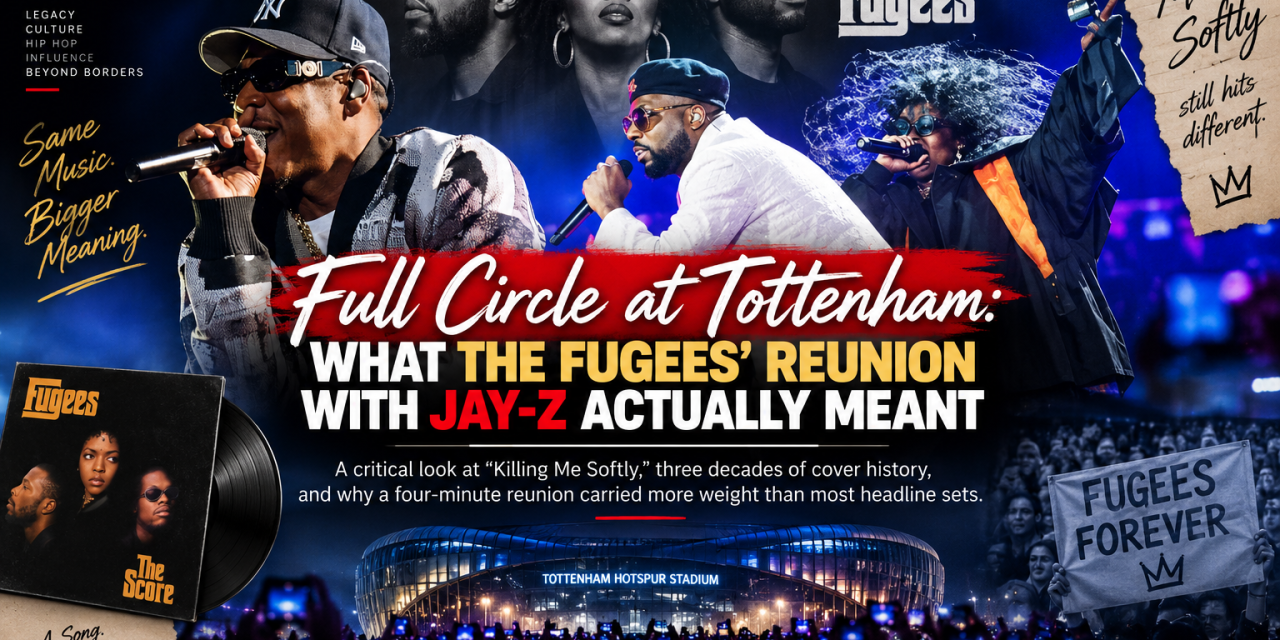
A critical look at “Killing Me Softly,” three decades of cover history, and why a four-minute reunion carried more weight than most headline sets
When Jay-Z brought out Lauryn Hill and Wyclef Jean at Tottenham Hotspur Stadium on September 4, 2026 — the opening night of his JAY-Z 30 tour, marking three decades since Reasonable Doubt — the moment that landed hardest wasn’t a career-spanning hit. It was three songs from someone else’s catalog: “Ready or Not,” “Fu-Gee-La,” and “Killing Me Softly With His Song.” Hill and Wyclef hadn’t shared a stage in years. That the reunion happened inside another artist’s anniversary show, rather than one of their own, is worth sitting with as a piece of criticism, not just a piece of news.
The Song Underneath the Song
“Killing Me Softly” is a useful lens for the whole night precisely because it wasn’t written for any of the artists who performed it. Charles Fox composed the music and Norman Gimbel wrote the lyrics, developing the song in collaboration with singer-songwriter Lori Lieberman, whose own account holds that the lyrics were inspired by an evening watching Don McLean perform. Lieberman recorded it first, in 1972. It took Roberta Flack’s 1973 version to turn it into a cultural landmark — a vocal performance so definitive that for a generation, the song simply was Flack’s. The Fugees’ 1996 cover, built around Wyclef Jean’s production and Hill’s vocal, didn’t try to outrun that history; it reinterpreted it, slowing the tempo, thickening the low end, and routing a torch song through a hip-hop sensibility that made it new again for an entirely different audience twenty-three years later.
That layered lineage — Lieberman’s confession, Flack’s definitive reading, the Fugees’ reinvention — is exactly why hearing Hill sing it again in 2026 carried the specific charge it did. A song about being emotionally exposed by someone else’s art, first offered as a diary entry, then as a soul standard, then as a hip-hop reclamation, was now being performed as a nostalgia piece for an audience mostly too young to have experienced any of its three prior eras live. That’s not a criticism of the moment — if anything, it’s the whole reason the moment worked. Multi-generational songs earn the right to keep changing hands.
The Reunion Itself
By most accounts from the night, this was Hill and Wyclef’s first shared stage in some time, and the emotional register of the performance reflected that. Jay-Z framed the moment in explicitly personal terms, telling the Tottenham crowd that the Fugees “took me out on my first European tour, opening up for them” — a detail that recontextualizes the whole segment. This wasn’t a headliner generously ceding the spotlight to legacy acts; it was a specific artist repaying a specific debt, decades later, in front of tens of thousands of people who likely had no idea the relationship went back that far. “Thank you, I appreciate you. I’m forever a fan,” he told them — a rare moment of a stadium-filling artist positioning himself as the supporting act in his own narrative.
Musically, the trio moved through “Ready or Not” and “Fu-Gee-La” with the loose, muscle-memory chemistry you’d expect from performers who built those songs together thirty years ago, before settling into “Killing Me Softly” as the emotional center of the run. AllHipHop’s coverage described the broader show as functioning “less like a typical concert” and “more like a coronation” — an apt frame for a night that also brought out Idris Elba, DJ Khaled, and Giggs, but the Fugees segment was the one moment that wasn’t really about Jay-Z’s own catalog at all. It was a tribute act, performed live, by the actual original artists, for an audience that got to witness something closer to living history than nostalgia programming.
Why It Landed
The Fugees have not released a studio album since The Score in 1996 — the same thirty-year anniversary math that structures Jay-Z’s own tour. That parallel wasn’t lost on Hill, who reportedly noted onstage that the group’s most significant releases lined up with the same timeline as Jay-Z’s catalog. Whether or not a full Fugees reunion ever follows this appearance — and nothing in the reporting around this show suggests one is imminent — the Tottenham performance worked as a standalone statement: proof that “Killing Me Softly,” a song that has now been reinvented three separate times by three separate eras of popular music, still has enough emotional voltage left to stop a stadium show built entirely around someone else’s career.
For a song born from one songwriter watching another performer and feeling seen by it, there’s a certain symmetry in it still doing exactly that — to a new artist, on a new stage, three decades on.