
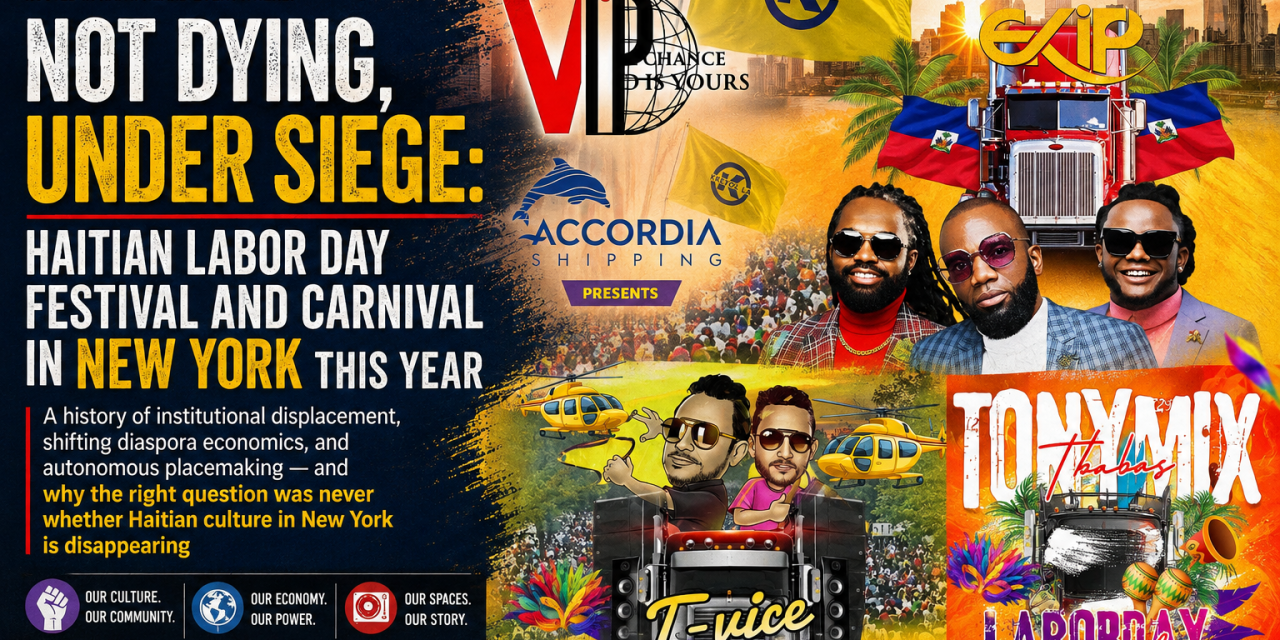
A history of institutional displacement, shifting diaspora economics, and autonomous placemaking — and why the right question was never whether Haitian culture in New York is disappearing
Every Labor Day, somewhere between one and three million people fill Eastern Parkway in Crown Heights for the West Indian American Day Carnival — Brooklyn’s largest single cultural event and, by some estimates, the largest Caribbean carnival in North America. Haitian flags have flown in that crowd since the carnival’s earliest Brooklyn years, and Haitian meringue-compas acts — T-Vice, Tabou Combo, Sweet Micky, Djakout, Carimi — have long been part of its soundscape. It would be easy, looking only at the numbers on a single Monday in September, to assume Haitian cultural presence in New York is simply thriving, unchanged, secure. It would also be easy, looking at the more troubled headlines about a “ghost town” in Little Haiti or declining mas band participation, to assume the opposite: that Haitian culture in Brooklyn is quietly dying out. Neither framing survives close examination. The more accurate — and more useful — story is one of a culture under structural siege, adapting in real time across three fronts: institutional representation, economic access, and legal precarity.
I. Institutional Displacement: A Century of Building Space Inside Someone Else’s Parade
The West Indian American Day Carnival’s own origin story is instructive. The tradition traces to the 1920s and ’30s, when Trinidadian immigrant Jessie Wardell and a circle of West Indian friends began hosting indoor costume parties in Harlem — private, enclosed substitutes for the open-air Carnival traditions colonial authorities had suppressed in the islands themselves. When the city revoked the Harlem parade’s permit in 1964 following a string of violent incidents, a committee led by Carlos Lezama regrouped and, by the late 1960s, relocated the celebration to Eastern Parkway in Crown Heights, forming what became the West Indian American Day Carnival Association (WIADCA) — the institutional home the parade has had ever since.
Haiti’s presence within that pan-Caribbean institution has always been real but structurally secondary — one flag among many within an association built, named, and led primarily around the Anglophone Caribbean. That mattered enough that Brooklyn’s Haitian community, whose population in Flatbush the 2013 American Community Survey placed near 50,000 (and whose broader Brooklyn Haitian-descent population Borough President Eric Adams once described by calling Brooklyn “the Port-au-Prince of America”), pursued its own, separate institutional recognition rather than relying solely on inclusion within WIADCA’s existing structure. In 2018, following months of advocacy led by Assembly Member Rodneyse Bichotte — the first Haitian-American woman elected to office in New York — the City Council formally designated Flatbush’s “Little Haiti Business and Cultural District,” spanning East 16th Street to Church Avenue to Brooklyn Avenue to Parkside Avenue. Council Member Jumaane Williams, who introduced the resolution, was explicit about the political stakes: the designation arrived, he said, specifically because “the President and his administration attack Haiti and its people,” making it “even more vital that this culture and its people are celebrated.”
That same logic of building autonomous institutional space rather than waiting for inclusion produced the Haitian Culture Day Parade, launched in 2019 as what founder Porez Luxama of Life of Hope described as a modest backyard gathering. By its sixth year in May 2025, it had grown into a major Church Avenue street event drawing hundreds of participants, four citywide elected officials, and — notably — its first-ever formal participation from WIADCA itself, a symbolic reversal in which the pan-Caribbean institution now shows up to support the Haitian-specific one, rather than the other way around. That sequence — Haitian community members building freestanding cultural infrastructure (a designated district, a standalone parade, a cultural center) alongside and outside existing pan-Caribbean institutions, which then eventually recognize and fold into that infrastructure — is the clearest empirical evidence against a “dying culture” narrative. Institutions do not proliferate around cultures in decline; they proliferate around cultures actively contesting their own visibility.
II. Shifting Diaspora Economics: Two Different Crises Wearing the Same Face
The economic pressure on Haitian cultural visibility in Brooklyn operates on two distinct tracks, and conflating them obscures what’s actually happening.
Track one: neighborhood-level gentrification. Little Haiti in Flatbush has the highest concentration of Haitian-owned businesses in New York City, according to Wikipedia’s documentation of the district, and remains home to institutions like the Little Haiti Cultural Center and Toussaint Louverture Boulevard. But reporting on the neighborhood in recent years — including a widely circulated account describing the area as an increasingly quiet “ghost town” — documents real displacement pressure: rising real estate prices pushing out longtime Haitian residents, traditional businesses replaced by cafes and boutiques catering to a wealthier, whiter clientele. The Haitian Times’ 2022 profile of a Nostrand Avenue sidewalk vendor, a machann selling goods residents “can hardly find elsewhere,” captured the texture of what’s being lost in granular terms: not abstract “culture,” but specific, irreplaceable informal-economy relationships between vendors and neighbors built over decades.
Track two: carnival-specific economic collapse. Separately, and on a different timeline, the mas band economy that gives Caribbean carnival its visual identity — the elaborate feathered and jeweled costumes synonymous with Eastern Parkway on Labor Day — is contracting sharply on its own terms. The number of participating mas bands fell from 35 in 2017 to just 18 in 2024, according to Columbia News Service reporting. Band leaders told Gothamist that new bands now need $15,000 to $25,000 in startup costs before a single costume is sold, with some paying $15,000 in vendor deposits alone before receiving a dollar from participants — driving multiple veteran bandleaders into debt or out of the parade entirely. Costumes that once ran $1,000 or more have pushed some organizers, like I AM CARIBBEING’s Monday Mas project in Flatbush, toward sub-$200 sustainable alternatives simply to keep the tradition financially accessible. Meanwhile, the carnival’s broader economic footprint — an estimated $300 million in annual revenue for New York City, per State Assembly Member Brian Cunningham — has increasingly corporatized around sponsored floats rather than costumed, culturally rooted mas bands, according to band leaders who describe the shift as eroding the event’s original pageantry.
These two tracks compound each other for Haitian cultural producers specifically: a Haitian mas band or vendor faces both the neighborhood-level displacement pressure documented in Little Haiti and the carnival-specific cost inflation documented on Eastern Parkway — two separate economic sieges landing on the same small population of cultural entrepreneurs.
III. The TPS Crisis: A Third Front That Makes the First Two More Dangerous
The institutional and economic pressures above would be serious in any political climate. They are landing now inside a legal crisis that makes public Haitian visibility itself carry risk. Following the U.S. Supreme Court’s June 2026 ruling in Mullin v. Doe, Haiti’s Temporary Protected Status designation formally terminated on July 27, 2026, ending legal status for an estimated 350,000 Haitians nationally — a population that overlaps substantially with the Flatbush and Little Haiti communities this article has described. Little Haiti BK’s own organizational materials name this explicitly among the threats facing Flatbush’s Haitian diaspora, citing “the possible expiration of Temporary Protected Status” alongside gentrification as twin forces “that jeopardize our safety and security.”
This is not a new dynamic, but a recurring one that has now recurred at a larger scale. Wikipedia’s documentation of Little Haiti, Brooklyn notes that during a prior 2021 TPS-related enforcement period, Haitian immigrants — including those with legal status — reacted by staying home, making the neighborhood’s streets “less vibrant temporarily,” even as Haitians of Haitian descent continued to be targeted that same summer. Documented’s 2025 reporting on the Haitian Culture Day Parade found organizers explicitly grappling with “the pressures of living under heightened immigration enforcement” even as they built the parade into a record-breaking celebration — meaning the same year produced both the parade’s most historic turnout and its organizers’ most acute fear.
This is the mechanism by which legal precarity converts into cultural invisibility, distinct from gentrification’s economic mechanism: it is not that TPS termination directly closes a business or cancels a parade. It’s that fear of enforcement suppresses the everyday public presence — the sidewalk vendor, the flag-waving spectator, the mas band participant who might otherwise be visible — that constitutes cultural visibility in practice. A culture can retain every institution it has built and still become less visible if the individuals who animate those institutions calculate that public presence now carries deportation risk.
The Bottom Line: Under Siege, Not Dying
Read individually, each thread in this story could support a decline narrative: an institutional history of playing junior partner within a pan-Caribbean association; a neighborhood hollowing out under gentrification; a carnival economy pricing out its own cultural producers; a legal crisis stripping hundreds of thousands of community members of the standing to appear in public without fear. Read together, a different pattern emerges. Haitian Brooklyn did not wait passively for institutional inclusion — it built the Little Haiti district, the Haitian Culture Day Parade, and organizations like Little Haiti BK from the ground up, autonomous infrastructure that WIADCA itself now shows up to support. Vendors like Little Haiti’s sidewalk machann and organizers like I AM CARIBBEING’s Monday Mas project are actively adapting economic models — sub-$200 sustainable costuming, informal-economy resilience — to route around cost barriers rather than simply exiting. And even amid an active TPS crisis, 2025’s Haitian Culture Day Parade posted its most historic turnout to date, elected officials and all.
That is not the profile of a dying culture. It is the profile of a culture absorbing simultaneous pressure from three different directions — institutional, economic, and legal — and responding to each with new infrastructure rather than retreat. Whether that infrastructure can outpace the pressure is the genuinely open question. But it is a fundamentally different question than whether Haitian culture in New York is disappearing, and conflating the two does a disservice to exactly the kind of active, contested placemaking this history actually shows.
Sources: Documented, Afropop Worldwide, 6sqft, Bklyner, Wikipedia (Little Haiti, Brooklyn; West Indian Day Parade), Little Haiti BK, Gothamist, Columbia News Service, East New York News, Grokipedia, CBS News New York, Congresswoman Yvette Clarke’s office, William Schwitzer & Associates. This report synthesizes historical, economic, and legal reporting to examine structural pressures on Haitian cultural visibility; it does not assert a single deterministic cause for any individual business, band, or institution’s specific circumstances.