
With no nationally elected officials since early 2023 and hundreds of entities registered for Haiti’s long-delayed electoral cycle, assessing a single coalition means untangling old networks wearing new names
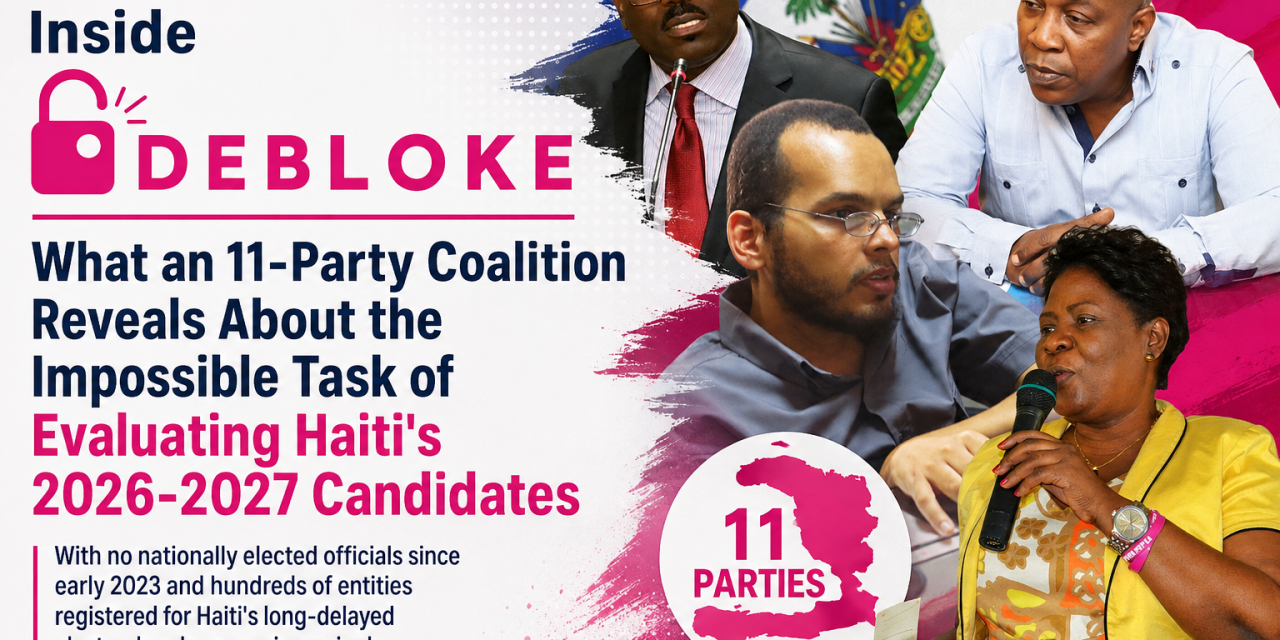
Evaluating a political platform in today’s Haiti is unlike evaluating one almost anywhere else. There has been no nationally elected government since early 2023. Armed groups control large stretches of the capital and now reach into outlying communes like Kenscoff. And as the Conseil Électoral Provisoire (CEP) prepares for the December 13, 2026 first round, hundreds of parties and groupements have registered — many of them newly formed alliances stitched together from the remnants of older, discredited political networks. DEBLOKE, an 11-party coalition led by former PHTK vice president Marie Yanick Mézile Lhérisson, is a useful test case for why this cycle is so hard to read at face value.
The Leadership: A Familiar Name in a New Coat
The official CEP registration document names Marie Yanick Mézile Lhérisson as DEBLOKE’s representative. That name carries real institutional weight in Haitian politics — and real institutional baggage.
Mézile served as Haiti’s Minister for the Status of Women and Women’s Rights from 2011 to January 2015 under the Martelly-Lamothe administration, was previously an assistant mayor of Port-au-Prince, and later served as mayor of Delmas. She went on to serve as Vice President of the Parti Haïtien Tèt Kale (PHTK) — the party built around former presidents Michel Martelly and Jovenel Moïse — and in 2018 was publicly insisting the party was “one and indivisible” amid reports of internal fracture. She subsequently became president of a smaller party, PLANSPA (Platfòm Nasyonal Sektè Popilè Ayisyen), after her husband, the party’s founder, died in April 2022.
That succession has not been clean. In March 2024, according to PLANSPA’s facebook page, nine of PLANSPA’s ten remaining executive committee members voted to remove Mézile Lhérisson from the party presidency, with the party’s legal counsel stating she no longer had authority to represent PLANSPA or act in its name — pending resolution, she disputed the legitimacy of that vote and pursued the matter through Port-au-Prince’s prosecutor’s office. That internal leadership dispute was reportedly still unresolved as of the time reporting was available. Separately, Mézile has faced accusations — not from a court, but from anonymous employees cited in Haitian press — of financial mismanagement during her tenure overseeing the OAVCT (Office of Vehicle Insurance and Traffic Accidents), allegations that remain unadjudicated. On the more institutionally credentialing side of her record, she was named in 2024 to a seven-member national Truth Commission alongside figures including then-Protecteur du Citoyen Renan Hédouville — itself worth noting given Hédouville subsequently became the subject of his own ULCC corruption investigation and is now, separately, in U.S. immigration detention.
What this tells you about DEBLOKE specifically: PHTK does not appear as a standalone entity in the CEP’s list of registered groupements — a detail that matters. When a political brand becomes too damaged to run under its own name, its networks, financing relationships, and organizers typically don’t disappear; they redistribute into new coalitions. Mézile’s DEBLOKE leadership role is a documented data point suggesting exactly that kind of redistribution, though it would be inaccurate to characterize the entire 11-party coalition as simply “PHTK renamed” — the other ten parties bring genuinely distinct histories, as the next section shows.
The 11 Parties: More Diversity Than the “Recycled Elite” Narrative Suggests
DEBLOKE is not a monolith, and a fair evaluation has to resist the temptation to reduce it to its most recognizable leader. The coalition’s other components include figures and platforms that complicate a simple “old guard in disguise” reading:
- Génération du Renouveau Patriotique (GREP) is fronted by Gerald Oriol Jr., a University of Florida and Harvard-educated disability-rights advocate who served as Haiti’s Secretary of State for the Integration of Persons with Disabilities from 2011 to 2020 — spanning both the Martelly and Moïse administrations — and who built his public profile as one of Haiti’s few senior officials living with a disability (spinal muscular atrophy) prior to entering government. His technocratic, service-delivery background is a genuinely different profile than Mézile’s party-apparatus career.
- Regroupement Planifié pour une Idéologie Continue (REPLIC) is led by Me Jacques Stevenson Thimoléon, a former deputy for Petit-Goâve who went on to serve as President of Haiti’s Chamber of Deputies from January 2014 to January 2016 — bringing a legislative, constituency-based background distinct from the executive-branch pedigrees of Mézile and Oriol. Notably, Thimoléon currently also holds a sitting executive-branch post as Director General of BMPAD (Bureau de Monétisation des Programmes d’Aide au Développement), installed in that role on March 25, 2026 — meaning he is simultaneously a government appointee and a coalition party leader positioning for December’s elections, a dual role worth flagging for readers tracking how transitional-era officials are navigating this cycle.
- Nouveau Parti pour la Renaissance d’Haïti (NOUPAREH) is led by Léon Ronsard Saint-Cyr, one of the coalition’s most experienced hands in security and interior governance. Saint-Cyr served as Minister of the Interior and Territorial Collectivities under the Martelly-Lamothe administration (installed August 2012), having previously served as Minister of Social Affairs and Labor within that same government. He later held a separate post, Secretary of State for Public Security, under a subsequent Jovenel Moïse-era government (named to the role in 2017) and again under a later Jovenel-Lafontant administration — distinct appointments in different governments, not concurrent with his Martelly-Lamothe tenure. His record predates those cabinet posts as well: he previously served as administrative director of Haiti’s national telecom utility (Teleco) under René Préval and as administrative director of the Police Nationale d’Haïti under the Aristide-Chérestal administration.
- Platfòm Nasyonal Sektè Popilè Ayisyen (PLANSPA), Mézile’s own smaller party, carries the largest social media following in the coalition (roughly 2,300 followers) but, per the internal leadership dispute described above, arrives with unresolved questions about who actually speaks for it.
- The remaining six parties — Fierté Nationale Haïtienne, Héritage 86 La Relève, Konbit Pou Remanbre Ayiti, Mobilisation des Ouvriers pour l’Unité Nationale, Mobilisation Organisationnelle des Patriotes, Rassemblement National des Collectivités Haïtiennes, and Repons Klas Mwayèn — present as considerably smaller, lower-profile organizations, several with social media followings in the tens to low hundreds, suggesting they bring more localized or niche constituencies (working-class representation, in REKLAM’s case, per its name; territorial-collectivity organizing, in RANACH’s case) rather than independent national reach.
The evaluation challenge this creates: a coalition assembled from one nationally recognized but politically damaged figure, one credentialed technocrat with a genuinely distinct base, one legislator-turned-sitting-government-appointee, one veteran of Haiti’s interior and public security apparatus spanning three separate administrations, and six smaller organizations of uncertain independent weight cannot be assessed as a single ideological bloc. Voters and observers evaluating DEBLOKE’s platform are, in effect, evaluating a negotiated alliance of convenience whose internal coherence — beyond the shared goal of electoral viability — is not yet demonstrated.
The Platform: Process Concerns Now, Substance Deferred
DEBLOKE’s actual public messaging to date, reflected in both its August 26, 2026 press note focuses almost entirely on procedural and logistical demands rather than a governing platform:
- A request that the CEP and government reexamine Article 153 of the June 2, 2026 electoral decree, which the coalition argues imposes administrative and documentary burdens on candidates that fall unevenly depending on where a candidate lives, their access to administrative services, and their financial means
- Explicit concern that insecurity and armed-group territorial control could prevent segments of the population from registering, accessing polling centers, or exercising their right to vote at all — with DEBLOKE calling on the government to help create the security and logistical conditions the CEP needs to fulfill its mission
- A demand for transparency, equal treatment, and predictability in how electoral rules are applied and communicated, specifically flagging concern over new deadlines that appeared on the CEP’s published calendar without what the coalition considered adequate advance notice
- Following the meeting, Prime Minister Alix Didier Fils-Aimé reportedly asked DEBLOKE to submit a structured memo detailing its concerns and proposals — meaning, as of this report, the coalition’s substantive governing platform remains a work in progress rather than a published document
What this reveals, evaluated against the standard the coalition’s own framing invites: DEBLOKE’s demands to date read as focused on securing a fair and viable competitive position for its own candidates within the current electoral process — reasonable and legitimate concerns given Haiti’s documented security crisis, but not yet a roadmap for actually neutralizing the gang violence that makes those concerns necessary in the first place. The coalition is asking the government to create the security conditions for the vote to happen; it has not yet publicly proposed how it would do so if elected. That distinction — between demanding conditions and proposing solutions — is likely to define how DEBLOKE, and many of the other newly formed groupements competing in this cycle, are ultimately judged once the requested “aide-mémoire” and any further platform documents become public.
Why This Case Illustrates the Broader Problem
DEBLOKE is one coalition among hundreds now registered with the CEP, and its internal mix — a nationally known but reputationally complicated party veteran, a credentialed technocrat, a former legislator, and several smaller localized organizations — is likely to be a common pattern across this electoral cycle rather than an outlier. In a political environment where established brands like PHTK are politically costly to run under directly, and where genuine, sustained party-building has been difficult amid years without functioning national government, coalitions like DEBLOKE function as vehicles that blend old political capital with newer or more specialized faces. Evaluating them fairly requires exactly the kind of disaggregation this report attempted: separating the coalition’s most visible leadership from its full membership, distinguishing verified biography from unresolved internal disputes, and distinguishing procedural demands from an actual governing platform — because in this electoral cycle, unlike more stable ones, the platform itself is often still being written in real time, in direct negotiation with the government whose performance the candidates are simultaneously campaigning against.
Sources: DEBLOKE official press note (August 26, 2026), CEP registration document, Wikipédia (Marie Yanick Mézil), Wikipedia (Gerald Oriol Jr.; Stevenson Jacques Thimoléon), Wikidata (opinion commentary, flagged as such). This report distinguishes documented biographical facts from unresolved internal party disputes and unadjudicated allegations throughout.