
After eight months of litigation, four months of intensive court-supervised negotiations, and three settlement conferences before a federal magistrate judge, a settlement in principle has been reached on all claims against all defendants — a significant victory for Haitian musical heritage and creator rights.
Legal News Analysis | Case No. 1:25-cv-2226 | U.S. District Court, Eastern District of New York | Settlement Reached June 25, 2026
The Settlement — What the Court Record Shows
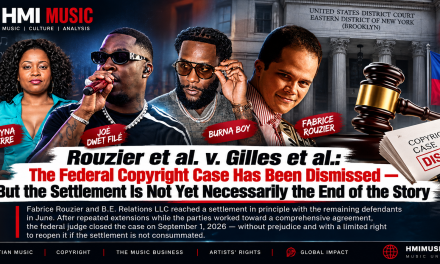
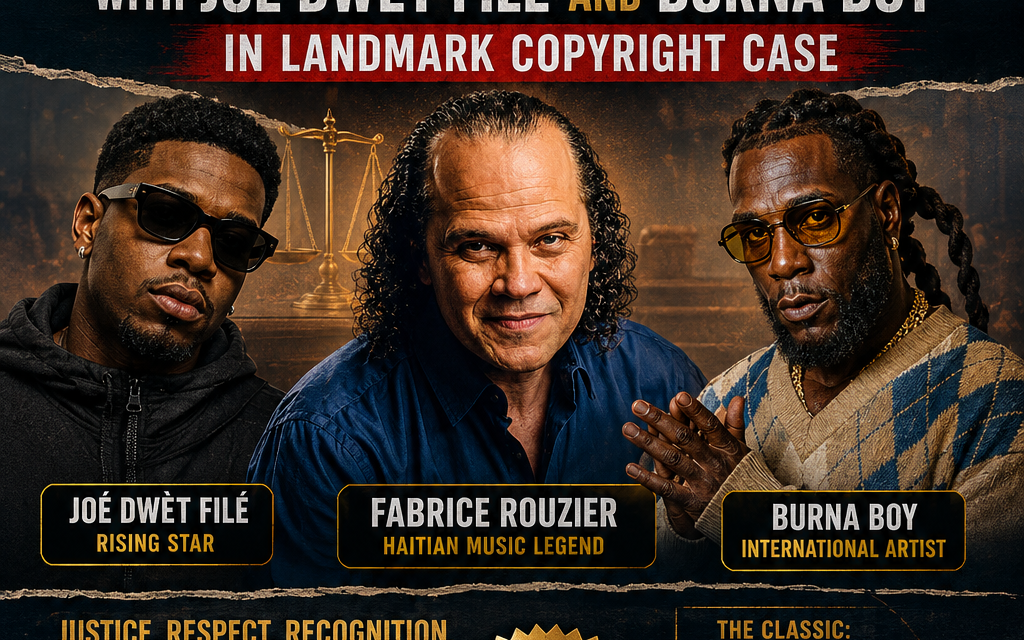
On June 25, 2026, Magistrate Judge Clay H. Kaminsky entered a minute entry confirming what the Haitian music community and the global entertainment industry had been watching closely for months: a settlement in principle was reached with respect to all claims and all parties in Fabrice Rouzier and B.E. Relations LLC v. Joe Gilles a/k/a Joé Dwèt Filé, DF Empire, Play Two, Damini Ogulu a/k/a Burna Boy, Atlantic Records Group, Universal Music Publishing France, and Daniel Fils Aimé a/k/a Tonton Bicha.
The parties have been directed to submit a stipulation of dismissal or other appropriate application to the court by August 3, 2026, which will formally close the case. The financial terms and specific conditions of the settlement are confidential, as is standard in court-supervised mediations of this nature. What the public docket does reveal, however, is a detailed procedural timeline that tells its own story about the complexity, seriousness, and ultimate resolution of this dispute.
The Road to Settlement: A Four-Month Negotiation Chronicle
The path from a copyright lawsuit to a global settlement was neither quick nor simple. The court docket reflects a structured, multi-stage negotiation process overseen personally by Magistrate Judge Clay H. Kaminsky — a process that required sustained effort from all parties across four distinct proceedings spanning April through June 2026.
April 17, 2026 — The Scheduling Order
Magistrate Judge Kaminsky issued a scheduling order setting a formal settlement conference for May 21, 2026 at 9:30 a.m. in Courtroom 504 North of the Eastern District courthouse. The parties were directed to review the settlement-conference section of the Court’s Individual Rules and to submit confidential, ex parte settlement statements via the judge’s Chambers email no later than May 14, 2026 — a standard practice that allows each side to present its private bottom-line position to the mediating judge without the other party seeing it.
The issuance of a formal settlement conference order at this stage signals that both sides had already signaled a willingness to explore resolution rather than proceed immediately to costly and unpredictable motion practice and eventual trial.
May 21, 2026 — The In-Person Settlement Conference: “Substantial Progress”
The first full settlement conference was held in person on May 21, 2026 — running from 9:38 a.m. to 5:33 p.m., a full-day session of nearly eight hours that reflects the genuine complexity and the number of parties involved.
The court minute entry records exactly who appeared:
- Kerry Ann Brennan of Brennan Law Firm PLLC appeared on behalf of plaintiffs Fabrice Rouzier and B.E. Relations LLC, joined by Fabrice Rouzier himself in person.
- David M. Given appeared on behalf of defendants Joe Gilles (Joé Dwèt Filé), DF Empire, and Play Two, joined by Pierre Miriel and Ruben Marce.
- Leonard F. Lesser and Madison M. Ault appeared on behalf of defendant Daniel Fils Aimé (Tonton Bicha).
The Burna Boy defendants — Atlantic Records Group and Universal Music Publishing France — are not separately listed in this minute entry, suggesting their counsel may have participated by phone or that their positions were addressed as part of the Dwèt Filé group’s representation for purposes of this session.
The outcome of that marathon day: the court recorded that substantial progress was made toward a global settlement, with the parties directed to continue negotiations on remaining open terms and to file a joint letter regarding their settlement status by May 29, 2026.
“Substantial progress” in a federal minute entry is a precise and meaningful phrase — it is not boilerplate optimism. It signals that the core financial and structural terms of a deal were within reach, and that what remained were details, not fundamental disagreements.
June 8, 2026 — First Telephone Conference: Ex Parte Calls
With negotiations continuing after the May 21 conference, Magistrate Judge Kaminsky held a telephone settlement conference on June 8, 2026, conducting ex parte calls with the parties separately. Ex parte calls at this stage of settlement mediation are a standard judicial tool: the judge speaks privately with each side to better understand their true positions, to reality-test each party’s expectations, and to help bridge remaining gaps without the adversarial dynamic of joint sessions. The fact that the judge personally engaged in this follow-up call — rather than leaving the parties to negotiate bilaterally on their own — signals that active judicial facilitation was still needed to close the deal.
June 16, 2026 — Second Telephone Conference: Further Ex Parte Engagement
A second telephone settlement conference followed on June 16, 2026, with the court again conducting an ex parte call in reference to settlement. Two separate judge-facilitated calls within eight days of each other indicates that the parties were close but navigating specific sticking points — likely involving the allocation of liability and payment among the multiple defendant groups (the Dwèt Filé defendants, the Burna Boy/Atlantic/Universal defendants, and Tonton Bicha’s separate counsel), and potentially involving questions about ongoing licensing, credit, and music platform obligations.
June 25, 2026 — The Resolution: “Settlement in Principle” on All Claims
The decisive session came on June 25, 2026. This time, Magistrate Judge Kaminsky held both ex parte and joint calls with the parties — a combination that reflects the final push to bridge remaining gaps: first, separate calls to finalize each side’s last position, then a joint call to confirm mutual agreement. The result was unambiguous. The court entered: “A settlement in principle was reached with respect to all claims and all parties.”
That phrase — all claims and all parties — is critically important. It means every count of the complaint was resolved: the copyright infringement claims regarding the 4 Kampe song, the 4 Kampe music video, the 4 Kampe II remix, and Tonton Bicha’s unauthorized performances, as well as the New York Civil Rights Law right-of-publicity claim regarding the unauthorized use of Rouzier’s image. Every defendant — from Dwèt Filé’s DF Empire to Burna Boy’s Atlantic Records and Universal Music Publishing France — is part of the global resolution.
What This Settlement Likely Means — Reading Between the Lines
While the specific terms are confidential, the structure and trajectory of the negotiations allow informed analysis of what a resolution of this kind typically encompasses:
Financial compensation to Rouzier and B.E. Relations. The core driver of litigation was that Rouzier and his publisher received zero payment while 4 Kampe generated 100 million YouTube Music streams alone, plus international touring revenue from performances with Usher and worldwide, and the additional streaming revenue from 4 Kampe II featuring one of Africa’s biggest global stars. Any settlement would be expected to include a lump-sum payment and/or ongoing royalty arrangement reflecting at least some portion of those revenues.
Retroactive licensing and publishing credit. Beyond money, settlements in music sampling cases often include formal retroactive licenses that acknowledge the plaintiff’s underlying work, plus corrections to publishing metadata across streaming platforms to reflect Rouzier’s compositional contribution. This matters enormously for a songwriter’s long-term income stream: correct metadata on Spotify, Apple Music, and YouTube ensures that future streams of 4 Kampe and 4 Kampe II generate publisher royalty payments that flow to B.E. Relations automatically.
Resolution of the image/right-of-publicity claim. The complaint’s Count V sought not only damages but the destruction of all copies of the 4 Kampe music video containing Rouzier’s image. In settlement, this likely resolved through either a takedown of the original video, an edited replacement version removing Rouzier’s likeness, or a payment in lieu of destruction — a practical compromise that avoids the commercial disruption of pulling a 100-million-play video entirely.
Tonton Bicha’s separate resolution. The fact that Tonton Bicha had separate counsel (Leonard F. Lesser and Madison M. Ault) and participated through separate representation throughout the conference indicates his share of liability was negotiated independently of the primary defendants. Given that his role was limited to the Brooklyn concert performance rather than the recording and distribution chain, his settlement contribution was almost certainly structured differently from that of the commercial defendants.
Why This Case Mattered — And Still Does
The settlement of Rouzier v. Dwèt Filé without trial does not diminish its significance for the music industry or for Haitian creative rights. In several respects, the outcome may be more meaningful precisely because it resolved through negotiation rather than a judicial ruling.
It validates the strength of Rouzier’s claims. Defendants with the resources of Atlantic Records and Universal Music Publishing France — who faced a complaint that included a defendant’s own on-record admission of intentional sampling — chose to settle rather than litigate. That is a market signal, not just a legal one. When major labels choose settlement over motion to dismiss in cases with this fact pattern, they are implicitly acknowledging the exposure.
It establishes a precedent in the Haitian music ecosystem. For decades, the cultural ubiquity of classic Haitian music within the diaspora has made it more vulnerable to unauthorized use, not less — because artists like Dwèt Filé recognized that sampling Je Vais would generate instant recognition and emotional connection among Haitian listeners. Rouzier’s case, and its resolution, sends a clear message: that cultural ubiquity is not a license. Recognition is not permission. And the same diaspora connection that makes a classic Haitian composition commercially valuable to a modern artist also makes the composer’s rights worth enforcing in federal court.
It demonstrates the global reach of U.S. copyright protection. The defendants included French companies (DF Empire, Play Two, Universal Music Publishing France), a Nigerian artist (Burna Boy), and a Florida-based actor (Tonton Bicha). All were brought within the jurisdiction of a single federal district court in Brooklyn, New York — and all ultimately reached resolution under U.S. copyright law. For Haitian and Caribbean creators whose work circulates globally through diaspora networks, this case is a practical demonstration that U.S. copyright registration and U.S. federal courts are accessible and effective tools, even against multi-jurisdictional defendants.
It carries a specific lesson for the sampling culture around legacy music. Dwèt Filé’s interview admission — that he sampled Je Vais specifically because “all Haitians know it” — is a direct window into how some artists think about legacy works from smaller cultural markets: as freely available raw material whose value derives from their canonical status, without that value belonging to anyone in particular. This case answered that assumption definitively. The canonical status of Je Vais made it worth protecting, not worth taking.
What Comes Next
The parties have until August 3, 2026 to file a stipulation of dismissal or other appropriate application with the court. Once filed and approved, the case will be formally closed. Magistrate Judge Kaminsky’s sustained personal involvement — from the April scheduling order through three conferences and six months of engagement — reflects both the complexity of the multiparty structure and the court’s commitment to facilitating resolution rather than prolonging litigation.
For Fabrice Rouzier, the settlement closes a legal chapter that began when he first sent a cease-and-desist letter on December 10, 2024. For the Haitian music community, it opens a broader conversation about how creators protect their legacies in an era when streaming platforms, diaspora audiences, and global genre-blending make classic recordings more accessible — and more exploitable — than ever before.
The music will keep playing. Now, at least, the composer will be paid.
This article is based exclusively on publicly available court docket entries in Case No. 1:25-cv-2226, United States District Court for the Eastern District of New York. Settlement terms are confidential and have not been disclosed publicly. Analysis of likely settlement terms represents informed legal commentary, not confirmed facts. This article does not constitute legal advice.