
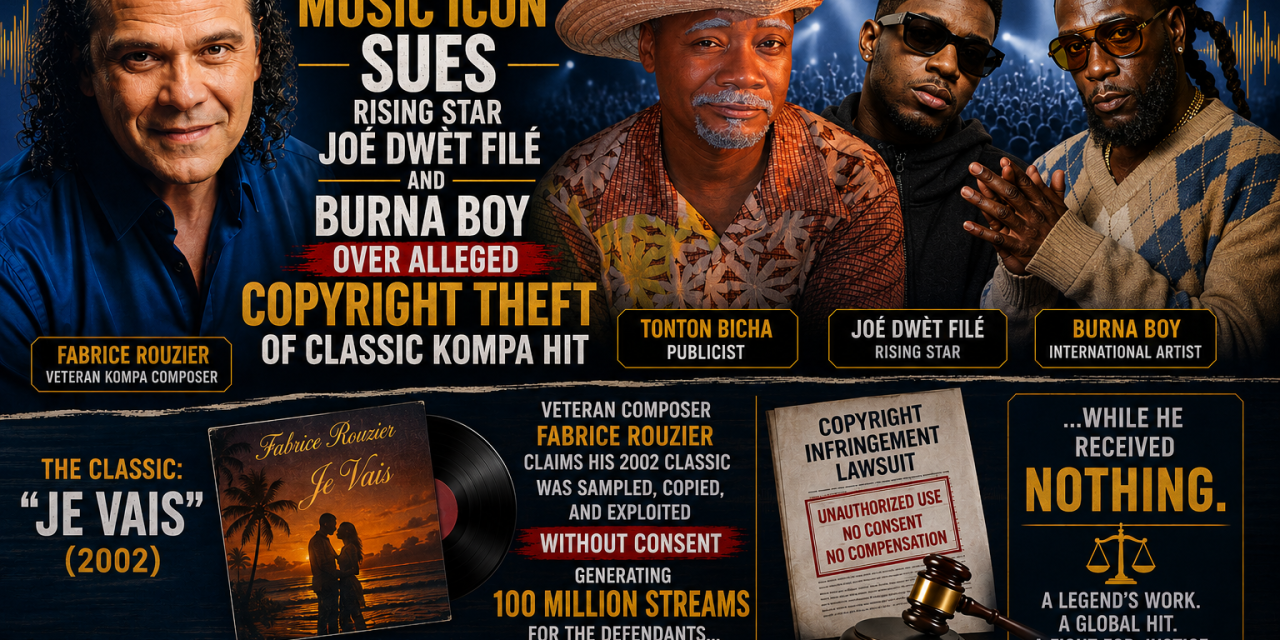
Veteran composer Fabrice Rouzier claims his 2002 classic “Je Vais” was sampled, copied, and exploited without consent — generating 100 million streams for the defendants while he received nothing.
Legal News Analysis | Case No. 1:25-cv-2226 | U.S. District Court, Eastern District of New York | Filed April 22, 2025
The Case at a Glance
A landmark copyright dispute at the crossroads of Haitian traditional music and modern Afrobeats has landed in federal court in Brooklyn. Legendary Haitian composer, pianist, and producer Fabrice Rouzier — credited with leaving his imprint on over 260 Haitian music albums in a career spanning more than 25 years — has filed suit against French-Haitian singer Joe Gilles, known professionally as Joé Dwèt Filé, his label DF Empire, French record company Play Two, Nigerian superstar Damini Ogulu a/k/a Burna Boy, Atlantic Records Group, Universal Music Publishing France, and comedic actor Daniel Fils Aimé a/k/a Tonton Bicha.
The complaint, filed April 22, 2025 by the Brennan Law Firm PLLC on behalf of Rouzier and his publishing company B.E. Relations LLC, asserts copyright infringement under the U.S. Copyright Act of 1976 and a separate right-of-publicity violation under New York Civil Rights Law §§ 50 and 51. The plaintiffs are seeking actual damages, statutory damages of up to $150,000 per willful infringement, disgorgement of all profits, attorneys’ fees, and permanent injunctions to stop the continued distribution and performance of the allegedly infringing works.
Who Are the Players?
Fabrice Rouzier is one of Haiti’s most respected musical figures — a classically trained pianist and prolific producer whose compositions have defined the sound of Haitian kompa and troubadour music for a generation. His publishing catalog is administered by his New York-based company, B.E. Relations LLC.
Joé Dwèt Filé is a French-Haitian singer who rose to international prominence in late 2024 with the explosive release of 4 Kampe, a track that generated massive streaming numbers across the Haitian diaspora and beyond, ultimately reaching 100 million plays on YouTube Music alone by April 17, 2025. He operates through DF Empire, a French company, and is distributed by French label Play Two.
Burna Boy is one of Africa’s biggest global music stars, a Grammy Award-winning Nigerian artist signed to Atlantic Records and published by Universal Music Publishing France. His involvement arises from his collaboration with Dwèt Filé on 4 Kampe II, a remix released on March 28, 2025.
Tonton Bicha is a Florida-based comedic actor who had been invited by Rouzier himself to perform portions of Je Vais in the original music video — and who later appeared alongside Dwèt Filé in the Brooklyn performance of 4 Kampe, allegedly without any authorization from Rouzier.
The Original Work: “Je Vais” (2002)
At the heart of this case is Je Vais — a song Fabrice Rouzier wrote, composed, and produced in 2002, which has since become a classic of Haitian troubadour music, widely known across the Haitian diaspora worldwide. The work tells the story of a man’s encounter with a young woman who quotes her rates in a memorable, playfully risqué narrative, and its chorus features the line — in Haitian Creole — “ak 20 dola ban-m 4 kanpe a 5 dola” (“with 20 dollars, give me 4 ‘standing up'”), with the refrain “4 kanpe” repeated throughout.
Rouzier holds registered U.S. copyrights in both the musical composition and lyrics (Registration No. PA 2-522-140) and the master sound recording (Registration No. SR 1-025-328), both issued effective February 4, 2025. A separate copyright application for the Je Vais music video was filed on April 21, 2025, just one day before the complaint was filed.
The Alleged Infringement: How “4 Kampe” Became a Legal Flashpoint
The Song
On or about October 25, 2024, Dwèt Filé released 4 Kampe — and the complaint methodically catalogs exactly what the plaintiffs allege was taken without authorization:
The title itself. The name 4 Kampe (“4 standing” in French) is drawn directly from the signature phrase “4 kanpe” that appears as a repeated refrain in Je Vais.
The narrative. The complaint alleges that 4 Kampe integrates the story framework of Je Vais into its own lyrics, building upon the same setup and intimate scenario that Rouzier created in 2002.
The sampled audio. According to the complaint, 4 Kampe directly incorporates audio excerpts taken from the master sound recording of Je Vais at multiple, specifically documented timestamps:
- In the introduction (00:00–00:20), three separate clips from Je Vais are compiled and looped.
- At the 2:55–2:58 mark in 4 Kampe, audio is taken directly from the Je Vais recording.
- At the 3:26–3:29 mark, another excerpt from the same source audio appears.
The admission. This is arguably the most damaging element of the plaintiffs’ case: in a recorded interview available online, Dwèt Filé stated in French — “C’est du Troubadours Je Vais, tu voir donc je voulais vraiment qu’il sample cette partie là, son Je Vais que tous les haitiens connaissent en vrai” — which translates as: “It’s the Troubadors Je Vais, so I really wanted to sample a part of Je Vais which all Haitians know in real life.” The complaint cites this as an explicit, on-record admission of intentional copying. Dwèt Filé reportedly chose to sample Je Vais precisely because it is so widely recognized among Haitians — meaning the entire commercial value proposition of 4 Kampe was built, in part, on the goodwill and recognition that Rouzier had spent two decades building.
The Music Video
The alleged infringement extends beyond the audio track. The official 4 Kampe music video, the complaint alleges, lifted at least eight distinct visual excerpts from Rouzier’s 2003 Je Vais music video, appearing at documented timestamps throughout: 01:10–01:11, 01:17–01:18, 01:57–01:58, 02:10–02:11, 02:52–02:53, 02:59–03:00, 03:15–03:16, and 03:21–03:23.
More significantly for the right-of-publicity claim: one of those excerpts is a full-frame image of Fabrice Rouzier himself, taken from the Je Vais video, and used in the 4 Kampe music video — without his written consent, approval, or any knowledge of the intended use.
The Brooklyn Performance
On November 29, 2024, Dwèt Filé performed 4 Kampe at a concert in Brooklyn, New York — bringing the alleged infringement squarely into the Eastern District’s venue jurisdiction. Crucially, he invited Tonton Bicha — the same comedic actor who had appeared in Rouzier’s original Je Vais video at Rouzier’s invitation — to join him on stage and perform portions of the Je Vais composition that had been incorporated into 4 Kampe. Dwèt Filé subsequently posted a clip of that performance on Instagram with the caption “Thanks New York” and a tag to Tonton Bicha’s account. Neither Dwèt Filé nor Tonton Bicha, the complaint alleges, had any authorization from Rouzier to publicly perform any portion of Je Vais.
The Burna Boy Remix: “4 Kampe II” and the Second Wave of Alleged Infringement
On March 28, 2025 — the same day plaintiffs’ counsel sent a cease-and-desist letter to the Burna Boy defendants — 4 Kampe II was released publicly. The timing is noted in the complaint as evidence of willfulness on the part of the Burna Boy defendants, who the complaint argues had explicit notice of Rouzier’s claims before participating in the remix’s creation and release.
4 Kampe II features Burna Boy alongside Dwèt Filé and, according to the complaint, continues to employ the same infringing lyrical refrain — “Cherie, ou sou sa kampe” in French (“Darling, if you are in the mood, let’s do this in the standing position”) — repeated multiple times, mirroring the narrative and phrasing that Rouzier created in 2002.
On at least one platform, the remix appears under the title Je Vais 4 Kampe, a fact the complaint treats as further evidence that the defendants’ own commercial presentation of the work openly acknowledges its derivation from Rouzier’s original.
The Claims: Five Counts Across Multiple Defendants
The complaint asserts five distinct counts:
Count I — Copyright Infringement (Dwèt Filé Defendants / 4 Kampe song): Unauthorized copying, sampling, distribution, public performance, and creation of a derivative work based on the Je Vais musical composition and sound recording.
Count II — Copyright Infringement (Dwèt Filé Defendants / 4 Kampe Music Video): Unauthorized reproduction and display of excerpts from the Je Vais music video — including Rouzier’s image — in the 4 Kampe music video.
Count III — Copyright Infringement (Dwèt Filé and Burna Boy Defendants / 4 Kampe II): The remix is alleged to be a further infringing derivative, with the Burna Boy defendants held to have proceeded knowingly after receiving the cease-and-desist correspondence.
Count IV — Copyright Infringement (Tonton Bicha): The Brooklyn performance by Tonton Bicha of Je Vais material incorporated into 4 Kampe, without authorization from the copyright owner.
Count V — Violation of New York Civil Rights Law §§ 50 and 51 (Dwèt Filé Defendants): The unauthorized commercial use of Rouzier’s image and likeness within the State of New York — specifically, the full-frame image of Rouzier taken from the Je Vais video and embedded in the 4 Kampe music video for advertising and promotional purposes, without his consent. This claim seeks compensatory damages, exemplary damages, and an order requiring the destruction of all copies of the infringing video.
What the Plaintiffs Are Seeking
The relief requested is sweeping. Plaintiffs seek:
- Actual damages and disgorgement of all profits attributable to the alleged infringement, to be proven at trial — a potentially significant sum given that 4 Kampe has been played 100 million times on YouTube Music alone, and has been performed worldwide including with Usher.
- Maximum statutory damages of $150,000 per willful infringement, which — across five counts and multiple works — could compound substantially.
- Preliminary and permanent injunctions halting all reproduction, distribution, sale, public performance, and other exploitation of 4 Kampe, 4 Kampe II, and the 4 Kampe music video.
- An order requiring the destruction of all copies of the infringing music video containing Rouzier’s image.
- Attorney’s fees and costs under 17 U.S.C. § 505.
- A jury trial on all triable issues.
Legal Analysis: The Plaintiffs’ Strengths
From a legal news perspective, several features of this complaint stand out as unusually strong for a plaintiff at the initial pleading stage:
The on-record admission is rare. Most copyright infringement cases require plaintiffs to prove access to the original work through circumstantial evidence. Here, the defendant himself stated on video — in quotable, translated detail — that he specifically chose to sample Je Vais because all Haitians would recognize it. That admission goes directly to both access and willfulness, two elements that are often hotly contested. It converts what would typically be a technical music-analysis dispute into a case with a central piece of testimonial evidence from the alleged infringer himself.
The specificity of the sampling evidence. The complaint does not rely on general claims of similarity. It identifies precise timestamps — both in 4 Kampe and in the corresponding portions of Je Vais — where audio was allegedly lifted directly. That level of specificity, if borne out by expert musicology analysis, makes a fair use defense considerably harder to mount.
The visual copyright and right-of-publicity claim are distinct and additive. Many music copyright cases focus solely on audio. By layering in the unauthorized use of Rouzier’s own image in the 4 Kampe music video — used, the complaint argues, to commercially leverage his identity and association with Je Vais — the plaintiffs add a New York statutory claim that operates independently of federal copyright law. Under Civil Rights Law § 51, the commercial use of a person’s image without consent for advertising purposes is actionable regardless of the copyright question.
The Burna Boy defendants’ timing is problematic. Releasing 4 Kampe II on the same day a cease-and-desist was sent — after the original 4 Kampe dispute was already public — is a fact pattern that tends to support an inference of willfulness. At the statutory damages phase, willfulness is the variable that moves the number from $30,000 per infringement to the $150,000 ceiling.
The Bigger Picture: A Watershed Moment for Haitian Music Rights
This case is larger than one composer and one song. Je Vais is an emblematic example of a pattern that has long frustrated artists from smaller, less commercially dominant music markets: their foundational works — known intimately within their own diaspora communities — are recognized as culturally valuable precisely because they are distinctive and universally known among Haitians, and that cultural ubiquity is then exploited commercially without compensation or credit.
Dwèt Filé’s own admission makes this explicit: he sampled Je Vais because all Haitians know it. That is a statement about the commercial utility of Rouzier’s decades of creative work and cultural reputation — and the complaint argues that utility was extracted without permission and without payment.
The involvement of Burna Boy and Atlantic Records/Universal Music Publishing France also elevates this beyond a regional Haitian music dispute into the global Afrobeats and music-industry infrastructure. 4 Kampe II is not a niche diaspora release; it is a commercially distributed, internationally streamed product backed by two of the music industry’s largest corporate players. The complaint alleges that both had notice of Rouzier’s claims before the remix’s release and proceeded anyway — a fact that, if proven, will shape not only the damages calculation but also the broader message the music industry takes from this case about how it handles legacy-market sampling.
What Happens Next
The case is before the U.S. District Court for the Eastern District of New York (Case No. 1:25-cv-2226, assigned to Judge NCM-CHK). With defendants spread across France, Nigeria, and New York — and with corporate entities including Atlantic Records (New York), Universal Music Publishing France (Paris), and Play Two (Paris) — service of process and jurisdictional questions will be early procedural battlegrounds. The French defendants in particular may contest personal jurisdiction, though the complaint grounds venue in New York through the Brooklyn concert performance and the New York offices of Atlantic Records.
A settlement is arguably the most commercially rational outcome for all parties. Dwèt Filé has already publicly acknowledged the sampling; the question is price. But Rouzier’s complaint signals a willingness to fight: it seeks not only money but injunctions, destruction of infringing copies, and full vindication of a catalogue that the plaintiff has spent a career building.
For Haiti’s music community, and for the broader diaspora creative ecosystem, this case is being watched closely. If Rouzier prevails — or achieves a meaningful settlement — it will send an unambiguous signal that the cultural inheritance of Haitian music is not a free resource available for sampling simply because the artists who created it are less commercially powerful than those who sample them.
This article is based exclusively on the publicly filed complaint, Case No. 1:25-cv-2226, United States District Court for the Eastern District of New York, filed April 22, 2025. The allegations described are the plaintiffs’ claims and have not been adjudicated. All defendants are presumed innocent unless and until proven otherwise in a court of law. This article does not constitute legal advice.