

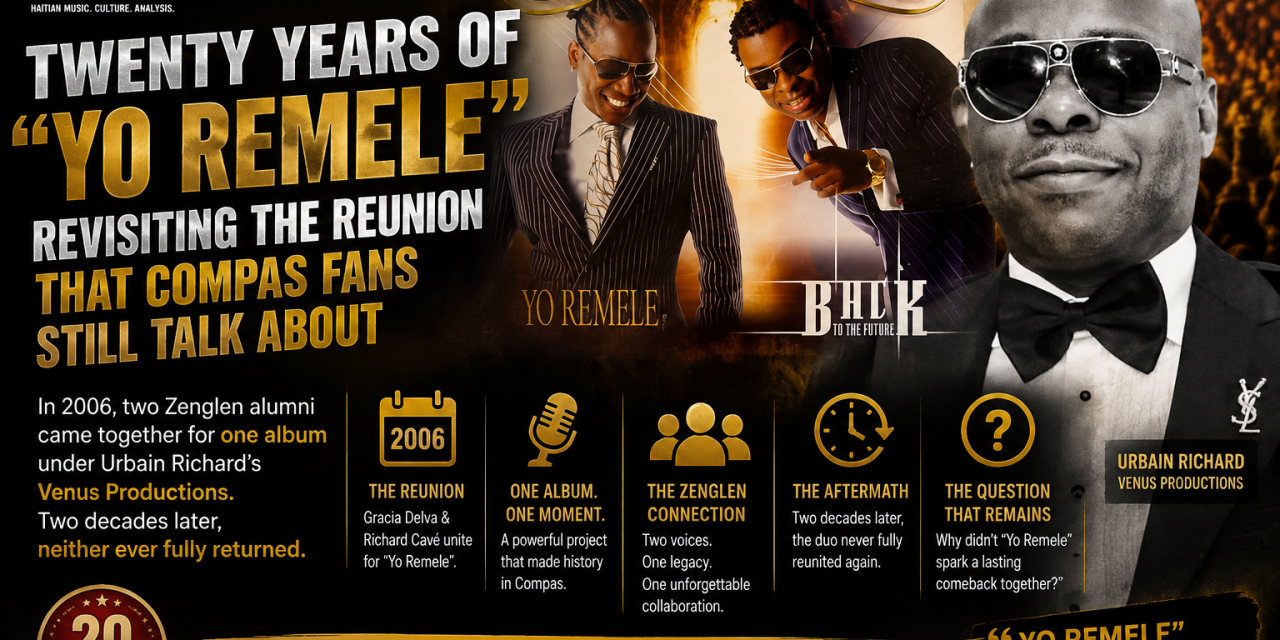
In 2006, two Zenglen alumni came together for one album under Urbain Richard’s Venus Productions. Two decades later, neither ever fully returned.
This year marks the 20th anniversary of Yo Remele, the 2006 reunion album by Gracia Delva and Jean Herard “Richie” Richard, released on Venus under the executive production of Urbain Richard’s Venus International Productions. Two decades on, it remains one of the most fondly remembered projects in modern compas — a brief, brilliant reunion between two men whose paths first crossed inside one of Haiti’s most storied bands, and who never shared a full-time lineup again after it.
Where Gracia and Richie Actually Came From: The Zenglen Story
To understand why Yo Remele mattered, you have to go back to Zenglen’s own origin. The band was founded in the 1980s in a Port-au-Prince suburb by three friends — Jean Brutus Dérissaint, Gary Didier Perez, and Patrick Martineau — whose shared love of music turned into daily jam sessions. The band’s name has a genuinely funny origin story: during one rehearsal, beer bottles vibrating off an amplifier shattered on the floor, and the group jokingly named themselves after the Creole word for the tiny shards of broken glass — zenglen.
The lineup that would eventually define Zenglen’s golden era didn’t come together until later. At the end of the 1990s, the band brought in drummer Richard Herard (Richie) and, shortly after, singer Gracia Delva — a pairing that pushed Zenglen to the front rank of competitive Konpa with the album Easy Konpa, a project built around hits substantial enough that Zenglen earned the nickname “The Compas University” for its influence on the genre. Under Dérissaint’s steady management, the band tackled subjects other groups avoided — drug use, unqualified show producers, taboo social topics — while Gracia and Richie’s chemistry as vocalist and maestro/drummer became one of the defining sounds of that Zenglen era.
Neither stayed permanently. Gracia Delva eventually left to found his own group in Haiti by the name of Mass Konpa; Richie went on to become a driving creative force in Zenglen and later founded his own group Klass in Florida, one of the most commercially dominant Konpa bands of the following two decades. By the time Yo Remele arrived in 2006, the two men had been apart from each other’s main projects for years — which is exactly what made a reunion album newsworthy in the first place.
That timeline matters for understanding Yo Remele‘s context: it was a reunion between two men who had each already built substantial, separate creative footing — one fully independent, one still anchored in the band they’d once shared — not two artists between projects looking for a permanent reunification.
The Album Itself
Yo Remele — the title track, alongside “Papa,” “St Valentin,” and “MMS” — became instant staples of 2000s Konpa, remembered by fans as proof of what these two heavyweights could produce when paired again. The album’s own subtitle, “Back to the Future,” signals how it was positioned from the outset: a nostalgic callback to their Zenglen-era chemistry, not a relaunch pitch for a new permanent group. Twelve tracks, released on Richard’s own Venus label, the album succeeded commercially and critically enough to be remembered, twenty years later, as a high-water mark of that specific creative partnership.
What Happened After — and What Didn’t
The most honest way to describe Yo Remele‘s legacy is this: it worked exactly as a one-time reunion, and nothing more. Gracia Delva returned fully to Mass Konpa and went on to build a significant political career in Haiti, serving as deputy for Marchand-Dessalines and later senator for Artibonite. Richie remained Zenglen’s maestro for several more years before striking out in 2012 to found Klass, which has since become one of the HMI’s most commercially dominant bands over the following decade-plus. Neither artist abandoned their creative footing after Yo Remele — Gracia was already fully independent, and Richie’s eventual departure from Zenglen to build Klass came years later and on its own separate timeline, unconnected to the reunion album.
Whether that outcome represents a “failure” on the part of Urbain Richard or Venus Productions is a harder claim to support than it might first appear. Remele met its own stated ambition. Judged against a broader, unstated hope that reunions like this one might someday pull the Haitian Music Industry’s biggest names into more permanent collaboration, it’s fair to say that hope has gone consistently unfulfilled — not just for Richard’s Venus Productions, but across the HMI generally, where similar one-off reunions and collaborations have repeatedly proven to be exactly that: one-off.
Twenty Years Later
Today, Gracia Delva and Richie remain on the separate paths they were already walking when Yo Remele was recorded — Delva in Haitian politics and Mass Konpa, Richie now over a decade into building Klass into one of the HMI’s most successful bands following his eventual 2012 departure from Zenglen. What hasn’t faded is the album itself: two decades on, “Yo Remele,” “Papa,” and “St Valentin” remain fixtures of the genre’s back catalog, still played, still requested, still cited by fans as the moment two of Konpa’s defining voices from the Zenglen era came back together — however briefly — to remind everyone why they mattered apart in the first place.