

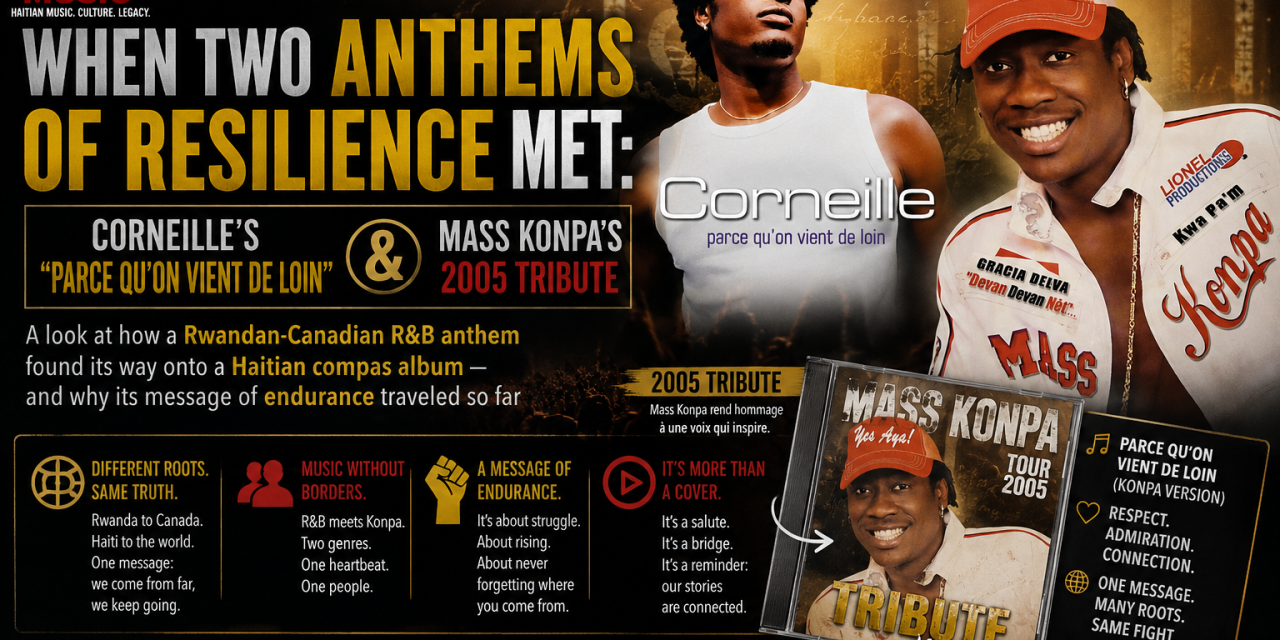
A look at how a Rwandan-Canadian R&B anthem found its way onto a Haitian compas album — and why its message of endurance traveled so far
In 2005, Gracia Delva’s band Mass Konpa released Kwa Pa’m – Devan Devan Nèt on the Lionel label (LION 0124) — a thirteen-track album anchored by its title cuts “Devan Devan Nèt” and “Kwa Pa’m.” Tucked into the back half of the tracklist, at position ten, sits a song sharing its title directly with one of the biggest Francophone hits of the preceding three years: “Parce qu’on vient de loin.”
The Original: Corneille’s Anthem of Survival
That title belongs first to Corneille — born Cornelius Nyungura on March 24, 1977, in Freiburg im Breisgau, West Germany, to Rwandan parents. Corneille spent most of his childhood in Rwanda before the defining rupture of his life: during the 1994 Rwandan genocide, at age 17, he witnessed the assassination of his parents and three siblings, targeted because his father was a political party leader. He survived, eventually returned to Germany, and emigrated to Quebec, Canada, in 1997, where he rebuilt both his life and his career from the ground up.
His September 2002 debut album, Parce qu’on vient de loin — released in Canada and expanded for the French market in 2003 — became a multi-platinum breakthrough, blending American soul and funk influences drawn from Prince, Stevie Wonder, and Marvin Gaye with deeply autobiographical French lyrics. The title track’s lyrics ask listeners to live each day as if it were the last, precisely because — as the refrain repeats — “on vient de loin”: we come from far. The song’s central image is explicit about what that distance means: surviving repeated brushes with the end of the world, and choosing, from that survival, to savor time rather than waste it. It became, and remains, a defining anthem of the French-language R&B catalog — a song whose meaning is inseparable from the specific atrocity Corneille lived through to write it.
The Tribute: Why a Haitian Band Would Reach for This Song
By the time Mass Konpa assembled Kwa Pa’m – Devan Devan Nèt in 2005, “Parce qu’on vient de loin” had already traveled well beyond Corneille’s own biography to become something closer to a shared Francophone anthem of endurance — covered, referenced, and performed across French-speaking musical communities precisely because its central message (survival as the foundation for living fully) resonated with audiences facing very different circumstances than Corneille’s own. Including a version of the song on a Haitian compas album fits that broader pattern: Haitian audiences, in Haiti and across the diaspora, have their own extensive, distinct history of upheaval, displacement, and resilience, and a song built entirely around the phrase “we come from far” offered a ready-made vessel for that sentiment, regardless of whether any specific band member’s own life story mirrored Corneille’s.
It’s worth being precise about what can and can’t be said here. This report has not identified any interview, liner note, or public statement in which Gracia Delva discusses why “Parce qu’on vient de loin” was included on this album, or what the song meant to him personally. What’s documented is the fact of its inclusion — track 10 on a 2005 Mass Konpa release — not the private reasoning behind it. Readers drawing their own connections between the song’s themes and Delva’s own life are engaging in the same kind of interpretation any listener brings to a cover song; that’s different from this outlet asserting a biographical claim it cannot support with a source.
Two Distinct Stories, One Shared Refrain
What can be said honestly is this: Corneille’s song became powerful enough, specific enough, and universal enough at once that a Haitian compas band chose to carry it into an entirely different musical and cultural context three years after its release — a testament to how far a song built from genuine survival can travel, and how many different listeners, for their own different reasons, can find themselves in its refrain. Corneille’s own story remains singular and should be understood on its own terms, rooted in the genocide he survived. What Mass Konpa’s 2005 tribute demonstrates is simply the reach of the song he built from it — proof that “we come from far” is a sentiment capable of speaking to audiences whose own distances, whatever they may be, are entirely their own to define.