

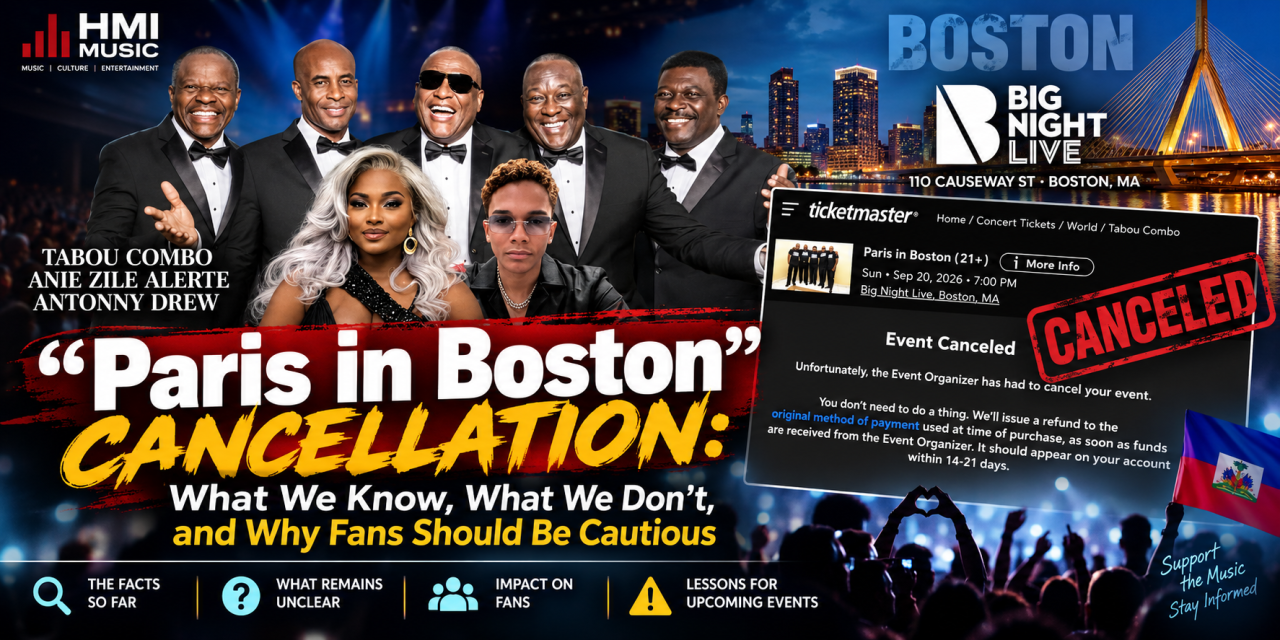
What’s Confirmed
Ticketmaster has declared the event canceled — the promoter has not. As of this writing, Ticketmaster’s listing for “Paris in Boston (21+),” originally scheduled for Sunday, September 20, 2026, at 7:00 PM at Big Night Live in Boston, displays a black banner reading “Event Canceled,” stating: “Unfortunately, the Event Organizer has had to cancel your event,” with automatic refunds promised within 14–21 days to the original payment method.
No public statement has come from the promotional team. Despite the show being days away, there has been no cancellation notice on the event’s official promotional channels — the same channels that, just days earlier, were actively counting down (“4 DAYS TO GO”) and pushing ticket sales for a headline lineup of Tabou Combo, Anie Zile Alerte, and Anthonny Drew, with music by DJ Super Duke and DJ Smoov.
Tickets reportedly remain on sale through a secondary channel. Most troubling for consumers: even after Ticketmaster marked the event canceled, tickets are reportedly still being sold through the event’s own website, ParisInBoston.com — one of the two official points of purchase listed on the promotional flyer alongside Ticketmaster. If accurate, this means fans could currently be paying for tickets to an event one official sales channel has already declared dead.
The Companies Behind the Show
Publicly available promotional material for “Paris in Boston” lists several production credits, including Gilbert Productions, Epim Pa Bon Production (Epim Pa Bon Entertainment), Castoring Productions, and BostonFete.com, alongside Ticketmaster as a ticketing partner.
- Gilbert Productions is an event promotion and entertainment company owned and operated by Haitian-American promoter Michael Gilbert, well known in the Haitian Music Industry (HMI) for large-scale productions — including bringing “Konpa En Symphony,” featuring maestro Arly Larivière and a full orchestra, to arenas like Miami’s Kaseya Center. Gilbert Productions has a track record of booking major konpa acts, including T-Vice and Anie Alerte Zile, in the Boston market specifically.
- Epim Pa Bon Production, also billed as Epim Pa Bon Entertainment, is a Boston-based promotional and music production entity in the Haitian-American music circuit, owned and operated by Rubens Joseph, who also performs as DJ Epimpamix.
It is not publicly clear from available materials which of the listed companies held final financial and legal responsibility for this specific date — a multi-promoter credit list is common in HMI concert production, where local promoters, national promoters, and marketing/print partners share billing without the public necessarily knowing who bore the ticketing liability or contractual risk for the show.
Possible Reasons for the Cancellation
Without an official statement from the promoter, any explanation is necessarily speculative. Based on patterns common to concert cancellations generally — and to HMI (Haitian Music Industry) events specifically, which have periodically faced similar last-minute disruptions — the following are plausible, non-exclusive explanations. None should be read as a confirmed cause absent an official statement:
-
Artist availability or routing conflict. Tabou Combo, Anie Alerte, and Anthonny Drew are all active touring artists with overlapping international schedules. A booking conflict, visa or travel issue (a recurring headache for Haiti-based or Haiti-touring artists), illness, or a last-minute change in an artist’s availability could force a promoter to pull an event rather than perform without a headline act.
-
Insufficient ticket sales. Concert promotion is a high fixed-cost business — venue rental, artist guarantees, staging, marketing — and promoters sometimes cancel shows that are not selling well enough to cover costs, particularly for a 21+ nightclub-style show competing with other HMI events on the fall calendar.
-
Venue-level issue. A scheduling conflict, licensing or permit issue, or an operational problem at Big Night Live itself could force a cancellation independent of the artists or promoter.
-
A dispute between promotional partners. When multiple production companies are credited on one event — as is the case here, with at least Gilbert Productions and Epim Pa Bon Production named alongside other marketing and print partners — a breakdown in the partnership, a disagreement over revenue splits, or unclear division of responsibility for deposits, guarantees, or ticketing can result in a show collapsing even after tickets have gone on sale.
-
Financial or contractual shortfall. Artist deposits, venue deposits, or production costs not being met on schedule can trigger a cancellation, particularly if a promoter is financing a show through advance ticket sales rather than committed capital.
-
Force majeure or unforeseen circumstance. Weather, a family or medical emergency involving a promoter or artist, or another unplanned event can also produce a late cancellation unrelated to sales or financial performance.
Because Ticketmaster’s cancellation notice uses the generic phrase “the Event Organizer has had to cancel your event” — standard boilerplate Ticketmaster uses regardless of cause — it offers no clue as to which, if any, of these scenarios applies here.
Why the Silence and Continued Ticket Sales Are the Real Story
The more urgent issue for consumers isn’t why the show was canceled — it’s the apparent gap between what Ticketmaster is telling buyers and what other channels may still be telling them.
- If ParisInBoston.com is still processing ticket sales for a show Ticketmaster has already marked “Event Canceled,” that is a serious consumer-protection concern. Fans buying through that channel now would be paying for a product one official sales partner has already confirmed does not exist as scheduled.
- The absence of any cancellation notice on the event’s own social media or promotional channels — even as the show date approaches — leaves fans who bought through Ticketmaster with no confirmation from the promoter itself of what happened, when it happened, or why.
- Ticketmaster’s own policy is unambiguous about how transferred tickets are handled: refunds go only to the original purchaser, not necessarily the person who ultimately held the ticket — which means fans who received tickets secondhand (a common practice in the HMI concert circuit, where group ticket purchases and resales are frequent) may not see any refund at all unless the original buyer passes it along.
What Ticket Holders Should Do
- Ticketmaster buyers: No action should be required; refunds are promised automatically within 14–21 days to the original payment method. Buyers should monitor their statements and contact Ticketmaster support directly if a refund does not appear in that window.
- Anyone who bought through ParisInBoston.com or another non-Ticketmaster channel: Given the apparent discrepancy, ticket holders should seek direct, written confirmation from the promoter (Gilbert Productions and/or Epim Pa Bon Production) of the event’s status and refund process before assuming Ticketmaster’s refund policy applies to their purchase, since third-party or website-direct sales are not always covered by Ticketmaster’s guarantee.
- Anyone who received a transferred ticket: Under Ticketmaster’s stated policy, any refund goes to the original purchaser, not the current holder — transferred-ticket recipients should contact whoever gave them the ticket.
The Bottom Line
As of publication, the only party that has said anything at all about this cancellation is Ticketmaster — using boilerplate language that explains nothing about why “Paris in Boston” was called off. The promotional entities behind the show, whose names and track records in the Haitian Music Industry are well established, have not yet addressed the cancellation publicly, and reports that tickets may still be for sale elsewhere raise real questions that only an official statement from the promoter can resolve. Until Gilbert Productions, Epim Pa Bon Production, or another party formally responsible for the show issues a clear public statement — addressing the cause of the cancellation, confirming that all sales channels have been halted, and laying out a refund process for buyers outside Ticketmaster — fans are left to rely on secondhand information and a generic cancellation banner to understand what happened to a show that, four days before it was to take place, was still being actively promoted as sold out and ready to go.
This report is based on publicly available promotional materials and the Ticketmaster event listing as of the time of writing. It does not allege wrongdoing by any individual or company; the explanations offered for the cancellation are presented as possibilities, not established facts, pending an official statement from the event’s organizers.