
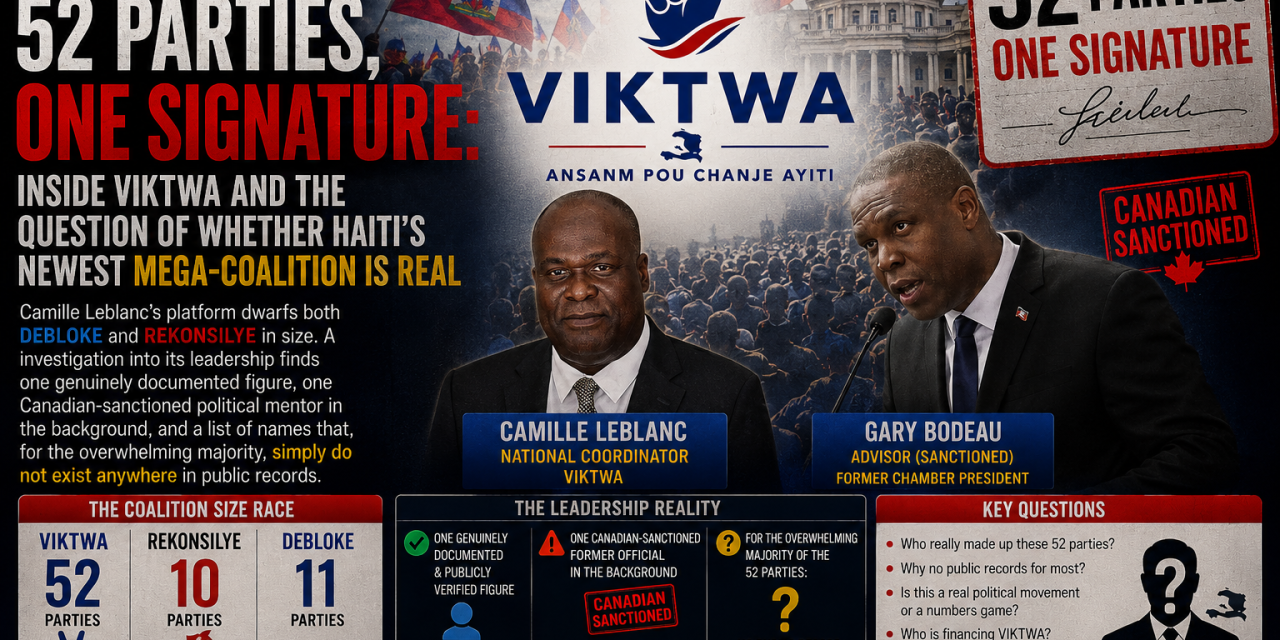
Camille Leblanc’s platform dwarfs both DEBLOKE and REKONSILYE in size. A investigation into its leadership finds one genuinely documented figure, one Canadian-sanctioned political mentor in the background, and a list of names that, for the overwhelming majority, simply do not exist anywhere in public records.
Platfòm VIKTWA, registered with Haiti’s Provisional Electoral Council under representative Camille Leblanc, is not a small coalition. Its own registration header lists “50” constituent parties; the actual enumerated list, reviewed directly for this report, runs to 52 — an internal discrepancy worth noting before even reaching the parties themselves, since it suggests either late additions to the roster or a documentation error that the CEP has not publicly clarified. Either way, VIKTWA is roughly five times the size of DEBLOKE (11 parties) and REKONSILYE (10 parties), the two coalitions this outlet has previously investigated. Scale alone raises the central question this report set out to answer: is a 52-party platform evidence of an unusually broad political tent, or evidence of something closer to what Haitian political observers colloquially call “parti fantôm” — phantom parties assembled primarily to pool paper membership rather than to represent distinct constituencies?
The One Verifiable Leader: Camille Leblanc
Camille Leblanc, the platform’s registered representative through his own party (Action Démocratique pour Bâtir Haïti, ADEBHA), is a genuinely documented figure — not a phantom name. Multiple independent sources, including a Canadian Immigration and Refugee Board country-condition report and a Haiti-Référence political directory citation dating back over a decade, confirm Leblanc as ADEBHA’s leader across multiple election cycles. But his more consequential and longer-running role, confirmed across media outlet reporting and official U.S. government sanctions-guarantee documentation, is as co-leader, alongside Jean-Henry Céant, of the party Renmen Ayiti (“Aimer Haïti” / “Love Haiti”) — the vehicle Céant used in both his 2010 and 2015 presidential runs. Media outlet archived reporting from that period describes Leblanc specifically as “President of the collective Aimer Haïti,” publicly welcoming Fanmi Lavalas figures’ endorsement of Céant’s candidacy — placing Leblanc, more than a decade before VIKTWA’s registration, already operating as a senior figure inside Céant’s political network.
That connection carries real weight for evaluating VIKTWA today, because of what happened to Céant since. On November 17, 2022, the Canadian government imposed formal sanctions against Jean-Henry Céant — jointly with former President Michel Martelly and former Prime Minister Laurent Lamothe — citing alleged “gross and systematic human rights violations in Haiti.” Specifically, Céant was accused of supporting violent armed gangs that terrorize the population — the same category of allegation this outlet has documented against Dimitri Vorbe and Réginald Boulos under separate U.S. sanctions actions. It is important to state precisely what this does and doesn’t establish: Leblanc himself has not been named in any sanctions action, and there is no public evidence he personally participated in whatever conduct Canada’s designation attributes to Céant. But Leblanc’s decade-plus career as Céant’s close political partner means VIKTWA’s most senior verifiable leader built his career in direct partnership with a man now under formal foreign-government sanction for alleged gang ties — a fact voters evaluating VIKTWA’s leadership are entitled to weigh, even without any allegation against Leblanc personally.
The Second Verifiable Figure: A Party Built From a Fanmi Lavalas Defection
Patrick Norzéus, listed as founder of Action Pour un Meilleur Environnement National (AMEN), is independently confirmed as a former Chamber of Deputies member representing Baradères/Grand Boucan under the Fanmi Lavalas banner — his service documented in the 2015 candidate registry and a 2016 sitting-deputies list from Rezo Nòdwès. More recent reporting from Gazette Haiti (December 2024) shows Norzéus remaining publicly active in Haiti’s post-2021 political crisis, taking a notable position opposing what he called a “third transition” and criticizing efforts to remove three indicted members of the Transitional Presidential Council — placing him as an active, still-engaged political voice as recently as late 2024, not a dormant figure resurrected only for VIKTWA’s registration.
The Rest: A Wall of Unverifiable Names
Beyond Leblanc and Norzéus, the verification record deteriorates sharply — and this deterioration is itself the most important finding of this investigation:
- APPA (Jhonny Jean Cerdieu Pongne): no public record of prior political organizing found; no website or social media presence for the party.
- APPREND: no individualized leadership named in CEP registries or media coverage at all — a party whose registered existence cannot currently be traced to any specific person.
- ARH (Fritz Sanon): described only as a militant/commentator with no legislative record; no independent web presence for the party.
- The remaining 47 parties on VIKTWA’s list — including AMEN, ACIREH, AYTO, CHASOLH, CAHDOA, and dozens more running through the alphabet to UNDH, ACL, and ASE — could not be matched to any independently identifiable leader, founding history, policy platform, or public communications channel through the research conducted for this report. Names like “Technocratie d’Action pour un Meilleur Leadership Eclairé et Organisé” (TEAMLEO) and “Parti pour la Réorganisation l’Ordre la Gouvernance et le Redressement Economique et Social” (LE PROGRES) suggest aspirational, acronym-driven branding more consistent with registration-filing exercises than with organizations that have held meetings, built membership, or communicated with the public under those names before this electoral cycle.
This is not a failure of this investigation’s search methodology — it is the finding. A party with a genuine base, however small, ordinarily leaves some trace: a Facebook page, a past candidate, a local news mention, a CEP historical filing from an earlier cycle. The near-total absence of that trace across roughly 90% of VIKTWA’s constituent parties is precisely the signature of what Haitian political analysts mean by “parti fantôm.”
Why Would 52 Phantom-Adjacent Parties Combine Into One Platform?
There’s a structural logic worth naming plainly, connecting directly back to reporting this outlet has already done on the CEP’s Article 139 requirement that every party demonstrate 30,000 verified members to register candidates — the same threshold FUSION/PFSDH publicly contested this August, and the same threshold that, as of early August, only 18 of over 300 aspiring parties had successfully cleared. A coalition structure allows dozens of small or nominal parties to pool membership claims toward a collective threshold that almost none of them could plausibly clear alone. Whether VIKTWA’s 52-party structure reflects that pooling dynamic specifically cannot be confirmed without access to the coalition’s actual submitted membership data — but the underlying incentive is documented, public CEP policy, not speculation.
Is VIKTWA “Just Like DEBLOKE”? No — It’s a Different, Arguably More Extreme Version of the Same Pattern
DEBLOKE, in this outlet’s prior investigation, showed a mixed but partially verifiable leadership bench: a nationally recognized (if reputationally complicated) figure in Marie Yanick Mézile, a credentialed technocrat in Gerald Oriol Jr., a sitting government official in Jacques Stevenson Thimoléon, and a multi-administration cabinet veteran in Léon Ronsard Saint-Cyr — alongside several genuinely obscure smaller parties. REKONSILYE showed a similar pattern at smaller scale, anchored by a sanctioned former Chamber president (Bodeau) and one party with genuine 1986-era historical standing (KID).
VIKTWA is different in degree, not just scale. Where DEBLOKE and REKONSILYE each had three or four independently verifiable figures anchoring a handful of unverifiable smaller parties, VIKTWA’s 52-party roster produces exactly two independently verifiable leaders — Leblanc and Norzéus — against a wall of dozens of parties with no discoverable public footprint whatsoever. Proportionally, VIKTWA shows meaningfully less verifiable institutional substance than either coalition this outlet has previously examined, even before accounting for the Céant-sanctions shadow hanging over its most senior confirmed leader.
The Bottom Line
VIKTWA is real in the sense that it is formally registered with Haiti’s CEP and led by a genuine, decades-documented political figure in Camille Leblanc — this is not a fabrication or a clerical fiction. But the coalition’s claim to represent 52 distinct political constituencies does not survive scrutiny: the overwhelming majority of its constituent parties leave no independent trace of ever having organized, campaigned, or communicated publicly before appearing on this registration list. Combined with Leblanc’s long political partnership with a Canadian-sanctioned figure accused of gang ties, and set against the CEP’s own 30,000-member threshold that gives small parties a structural incentive to combine into exactly this kind of oversized coalition, the evidence supports treating VIKTWA less as a broad-based popular movement and more as a strategic aggregation vehicle — real at its core, but padded substantially at its edges. Voters deserve to know which is which before December’s vote, and on the current public record, this report could not verify the large majority of VIKTWA’s claimed membership as anything more than a name on a list.
Sources: CEP registration document (Platfòm VIKTWA), Wikipedia (Renmen Ayiti; Jean-Henry Céant), Immigration and Refugee Board of Canada country documentation, Global Affairs Canada sanctions announcement (November 17, 2022), eSAR political directory. This report distinguishes independently verified biographical facts from unverifiable claims throughout; the absence of public records for the majority of named parties is treated as a reportable finding, not asserted proof of fraud or bad faith by any specific individual.