

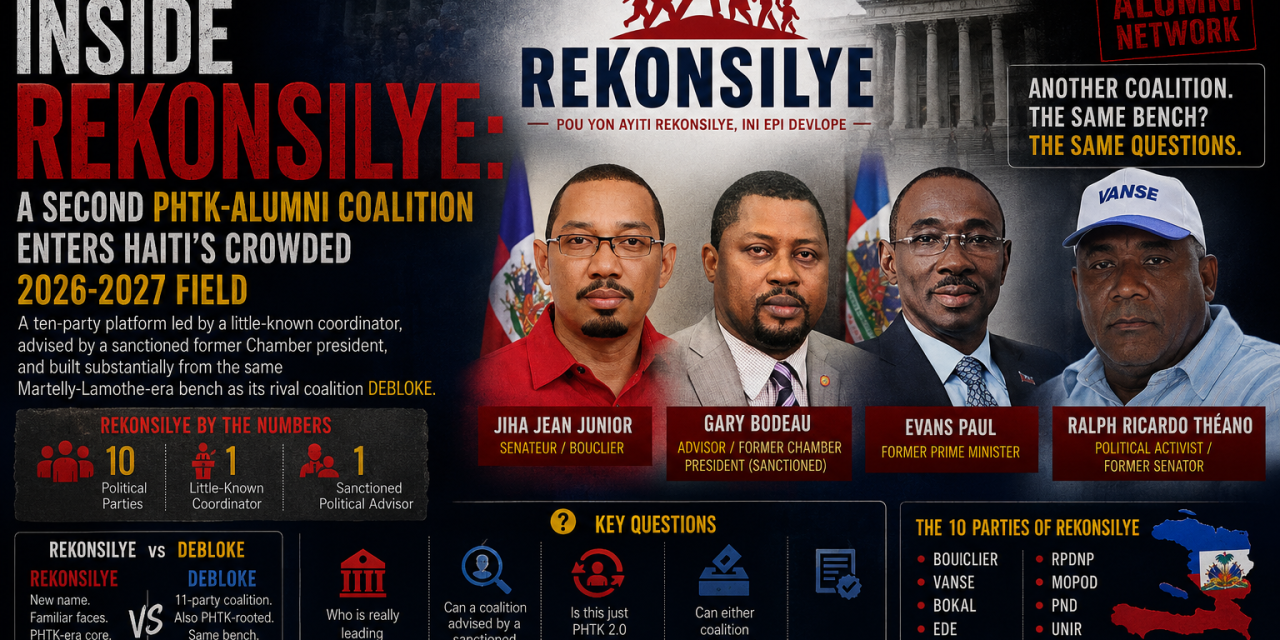
Led by a former Senate candidate from the Plateau Central, aiming to become “the largest political platform the country has known in thirty years” — but built substantially from one-man parties, dormant social media pages, and a name that appears twice on its own membership list
Evaluating a coalition in Haiti’s current electoral cycle means doing archaeology as much as journalism. With no nationally elected government since early 2023, gangs controlling the bulk of Port-au-Prince, and 208 political parties distributed across just 15 CEP-approved groupements as of mid-August 2026, assessing any single platform requires separating genuine institutional continuity from freshly assembled shells built to clear a registration bar. Platfòm REKONSILYE — 10 parties, formally registered with the CEP on March 12, 2026 — is a clean test case for exactly that kind of evaluation.
The Leadership
REKONSILYE is led by Jean Junior Jiha, a former Senate candidate for the Plateau Central department, who serves as the platform’s president and its officially designated CEP representative. He is joined by a defined executive structure: Jn Charles Arios as first vice president for strategic affairs, Wanique Pierre as second vice president for political affairs, Jose Daniel as vice president of the political bureau, and Steevenson Telfort — the compas artist known as Rockfam — as vice president for youth and university affairs. That last detail is notable on its own: recruiting a recognized musician into a formal party leadership role is a deliberate youth-outreach and visibility strategy, not an accident.
Jiha has been explicit about the platform’s ambitions, telling reporters the March CEP registration sends “a clear message for the Plateau Central and for the whole country” and that REKONSILYE intends to compete “at all levels — local, municipal, legislative, or national.” Platform leadership has separately stated REKONSILYE aims to become the largest political platform Haiti has seen in three decades — an explicitly outsized ambition worth measuring against what the platform’s constituent parts actually look like up close.
The Gary Bodeau Question
The most immediately newsworthy figure associated with REKONSILYE is not its formal president but Gary Bodeau, the former President of Haiti’s Chamber of Deputies (2018-2020) — profiled in depth by this outlet previously — who holds the role of special advisor within the platform. It’s worth being precise about a structural detail that could otherwise cause confusion: Bodeau is listed separately as president of REKONSILYE (RIEN), one of the ten individual parties that make up the broader REKONSILYE platform — meaning the platform and one of its ten constituent parties share the same name, with Bodeau leading the smaller party while Jiha leads the overall coalition.
This outlet has previously documented that Bodeau was sanctioned by the U.S. Treasury’s Office of Foreign Assets Control on April 5, 2023, and separately by Canada in November 2022, for alleged corruption and vote-buying schemes during his tenure as Chamber president — allegations he disputes and for which he has not been criminally convicted in a Haitian court. His public re-emergence at REKONSILYE’s launch event, following what Juno7 described as “a long period of media discretion,” and his subsequent public comments on the elections, the Fils-Aimé government, and his own political future, represent the clearest evidence yet that this platform is functioning, at least partly, as a vehicle for his political comeback.
Mapping the Ten Parties: Institutional Depth Concentrated in One Corner
A close look at REKONSILYE’s ten components reveals a coalition with almost all of its institutional weight concentrated in a single member party, surrounded by structures with little independent public footprint:
- Konvansyon Inite Demokratik (KID) is, by a wide margin, the platform’s most institutionally significant member — a party founded in 1986 by Evans Paul, who went on to serve as Haiti’s Prime Minister under both the Martelly administration and interim president Jocelerme Privert (2015-2016). KID won 2 Senate seats and 7 Chamber of Deputies seats after the 2015-16 elections and has a documented history of alliance-building, including a prior electoral partnership (Alyans) with the People’s Party for Haiti’s Rebirth, and — notably, given the question of PHTK ties — Evans Paul’s own service as prime minister under Martelly’s PHTK-led government represents KID’s most direct historical link to that political network, even though KID has functioned as a formally separate party rather than a PHTK subsidiary. KID formally joined REKONSILYE on August 6, 2026, according to platform officials — meaning the coalition’s most credentialed member is also its newest addition. Locally, KID is represented within REKONSILYE by Alfredo Antoine, a former deputy for Kenscoff — a name carrying particular resonance given that commune’s recent massacre, covered extensively by this outlet.
- Parti Réformiste Pour l’Émancipation du Peuple (PREPEP), led by human rights lawyer Wilfrid Vital, brings the platform’s second-most substantial public footprint, with 6,700 Facebook followers — a genuinely significant following relative to nearly every other party in this coalition, and a leadership background (human rights law) distinct from the party-apparatus or ministerial pedigrees found elsewhere in the platform.
- Kombite National pour le Développement Économique et Social d’Haïti (KONADESH) is coordinated by Ralph Ricardo Théano, a former Minister-Delegate to the Prime Minister in Charge of Relations with Parliament under the Martelly-Lamothe administration — another data point in REKONSILYE’s recurring pattern of drawing leadership from that specific administration’s alumni network, alongside Bodeau’s own Chamber presidency under the same broader PHTK era.
- Parti Reconstruire Haïti (RH/RHPREH) is led by Olicier Périché, a former Minister of Haitians Living Abroad (MHAVE) — another cabinet-level PHTK-era alumnus, and, per available public information, functionally a one-man operation with no independent web presence documenting a broader party structure.
- Parti Agricole Haïtien (PAH), led by Secretary General Davilma Romuald, has just 69 Facebook followers and 2 following — among the smallest public footprints of any party surveyed across this outlet’s recent coalition investigations.
- Konbit Aksyon pou Devlope Ayiti (KAD-AYITI), led by president Serge Gaspard, has no available website detailing a political program.
- Mouvement d’Union Républicaine (MUR), founded in 2019, has no identifiable social media page or website at all.
- Organisation Politique Sove Ayiti (OPSA) and Rapwoche similarly show no independently verifiable online presence or program documentation as of this report.
Why the 30,000-Member Threshold Makes This Pattern Structurally Important
This outlet has previously reported on the CEP’s Article 139 requirement that every party demonstrate 30,000 verified members, adherents, or sympathizers to register candidates — and on FUSION/PFSDH’s public complaint that the requirement’s data-validation system is producing false rejections even for established parties. REKONSILYE’s structure suggests a different, complementary strategy for clearing that same bar: rather than one party independently proving out 30,000 verified members, a platform assembles ten parties — several with minimal or no independently verifiable base — under one umbrella, in which the aggregate membership claim may lean heavily on whichever constituent party (in this case, most plausibly KID, PREPEP, or Bodeau’s own RIEN, given his national profile) can actually contribute meaningful, verifiable numbers. Six of the ten parties profiled here show no discoverable political program, and at least four show no meaningful public following at all — raising a fair question about how much of REKONSILYE’s claimed base reflects genuine grassroots membership versus administrative aggregation across a coalition assembled specifically to meet a registration threshold.
What This Means for Evaluating the Platform’s Substance
REKONSILYE’s public messaging, per Bodeau’s own comments following the launch event, centers on contributing to the country’s reconstruction “in a spirit of unity and solidarity” and accompanying the population in “the search for solutions” — language that, like DEBLOKE’s early public messaging profiled previously by this outlet, remains at the level of stated values rather than a specific, actionable governing platform. As of this report, no detailed REKONSILYE policy document addressing the security crisis, the electoral calendar, or economic recovery has been made public beyond these general framing statements.
The Bottom Line
REKONSILYE presents Haitian voters with a familiar evaluation problem in an unfamiliar configuration: a platform whose most experienced political capital comes from PHTK-era ministerial alumni (Bodeau, Théano, Périché) and one long-standing, independently credentialed party (KID) — all wrapped around a majority of smaller constituent parties with negligible independent public presence. Whether REKONSILYE represents a genuine ten-party coalition of distinct political constituencies, or a vehicle primarily built to relaunch the careers of specific PHTK-era figures like Bodeau while satisfying the CEP’s aggregate-membership threshold, is not a question the available public record can fully settle. Both readings are consistent with the facts as documented. The platform’s own ambition — to become the largest political force Haiti has seen in thirty years — will be tested first by whether it can actually clear the CEP’s registration requirements its own structure appears designed to game, and only much later, if it clears that bar, by whether Haitian voters see something more substantive on offer than reconciliation as a slogan.
Sources: Wikipedia (Gary Bodeau; Konvansyon Inite Demokratik/Convention for Democratic Unity; Evans Paul), CIA World Factbook (Political Parties and Leaders, Haiti), CEP official registration documents, National Association of Haitian-American Professionals (NAAHP). This report distinguishes documented facts from structural inference throughout; no party’s actual membership figures have been independently verified, and Bodeau’s underlying corruption allegations remain sanctions-based findings rather than criminal convictions.