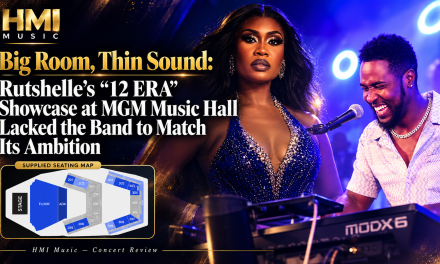


A full room, a sales claim and a profitable production are different things. The HMI deserves a clear explanation of each.
A sellout is a claim about ticket inventory. It needs a defined quantity, a clear scope and a time. A crowded photograph, an excited audience or a promoter’s triumphant interview cannot independently establish how many tickets were paid for.
That distinction belongs at the center of the discussion about Rutshelle Guillaume’s October 11, 2026, 12 ERA concert at MGM Music Hall at Fenway. Rutshelle’s achievement in headlining the venue deserves recognition. The accompanying sales claims deserve the same precision that any major HMI production should face.
What “sold out” should tell the public
In ordinary commercial terms, a concert sells out when all tickets offered for sale within its stated scope have been sold. Responsible reporting identifies the event’s saleable inventory and explains meaningful exclusions. “The presale sold out,” “VIP sold out,” and “the whole concert sold out” are different claims.
Start with the show’s configuration. Live Nation describes MGM Music Hall as a venue of approximately 5,000 capacity with flexible layouts. That general capacity is not a certified count of tickets offered for 12 ERA. Stage placement, production equipment, blocked sightlines and the areas opened for the show can affect the inventory. [1]
Next, reconcile paid tickets, complimentary admissions, holds and unsold tickets. Complimentary tickets use capacity but are not paid sales. Quicket’s own documentation explicitly distinguishes complimentary tickets from the inventory left for purchase. This illustrates a general accounting distinction; it does not establish which allocations were used at 12 ERA. [3]
| Measure | What it establishes |
|---|---|
| Paid tickets | Completed purchases, reconciled with cancellations and refunds. |
| Tickets distributed | Paid tickets plus complimentary or other allocated admissions, with categories explained. |
| Attendance | People admitted; normally checked against valid entry records and other authorized admissions. |
| Profit | Revenue remaining after the relevant expenses and contractual allocations. |
A simple illustration makes the point. Suppose a hypothetical venue can hold 5,000 people, but a documented production layout permits 4,500 admissions. If 300 are complimentary and all remaining 4,200 tickets sell, the paid inventory has sold out. The accurate account is 4,200 paid tickets and 300 complimentary allocations in that configuration. It is not 5,000 paid tickets. These numbers are illustrative, not estimates for 12 ERA.
Removing unsold tickets from sale does not turn them into purchases. Any claim based on a reduced configuration should explain the configuration and material changes to it.
Why a website label or ticket map needs context
Ticket availability changes. Ticketmaster explains that production adjustments can release additional tickets even after an event has sold out. A later standard-ticket listing therefore requires an explanation of timing and inventory; it does not automatically prove an earlier announcement was false. Resale listings also concern tickets already purchased, rather than necessarily unsold primary inventory. [2]
The same care applies to a gray map, an unavailable floor section or a “sales ended” notice. Availability alone does not identify every ticket’s financial status. A timestamped sales report and inventory history provide stronger evidence than interpreting colors in isolation.
Discounts and bundles remain legitimate paid sales when payment is completed. Sponsor-purchased tickets should be distinguished from free sponsor allocations. Empty seats can result from no-shows, and a full-looking room can include invited guests. Neither observation settles the accounting.
What is established about 12 ERA?
Published coverage has described 12 ERA as sold out. Imaj La reported that status on the official concert website and credited Mickaël Marabou with marketing and promotional contributions. Those are relevant published accounts, but the article reviewed does not reproduce a final box-office reconciliation. [5]
HMI Music has not reviewed a venue-certified final sales report, complete inventory history or reconciled admission count for this article. Our conclusion is therefore specific: the sellout claim has been reported, but we cannot independently verify its numerical basis from the records reviewed. That is not a finding that the concert failed or that its promoters lied.
Michael Marabou’s victory narrative needs measurable support
In the supplied MagHaiti post, Marabou is portrayed as having pursued the project despite industry figures’ warnings and committed fully with the Clasic 1804 team. The post concludes that the gamble paid off with a sellout. The excerpt does not identify those figures, and it does not show Marabou literally calling herself a “sold-out guru.” Those descriptions should not be invented or presented as direct quotations. [6]
Her confidence and promotional work are fair subjects for recognition. But when an event becomes a platform for answering doubters and establishing a reputation for concert expertise, the results should be open to scrutiny. Telling a story about people who advised against a project does not explain the sales total, the revenue or the outcome against the original budget.
The strongest response to those doubts would be a verifiable case study: the initial inventory, the campaign timeline, paid sales, complimentary allocations and an explanation of the team’s contribution. Repeatable expertise is demonstrated through documented results across projects. One celebratory account cannot establish that record on its own.
A successful concert is also a collective achievement involving the artist, audience, venue, production workers, musicians, marketing team and partners. Sales credit should reflect the evidence of those contributions.
Five questions that would move the discussion forward
- How many tickets were offered for sale for the final 12 ERA configuration, and what inventory changes occurred?
- How many paid tickets remained valid after refunds and cancellations, and how many complimentary or sponsor-allocated tickets were issued?
- When was the sellout reached, what inventory did that claim cover, and were tickets subsequently released?
- How many unique ticketed admissions were recorded, separating paid and complimentary tickets and explaining other authorized admissions?
- Will the authorized organizers publish a redacted venue or ticketing-provider summary supporting these figures?
Customer identities, payment details and confidential contract terms can remain private. An authenticated aggregate report can answer the sales question without publishing every business record. Eventim’s reporting documentation, for example, separates purchased, complimentary and refunded tickets from entry-scan data. Those distinctions are normal reporting tools. [4]
A sellout and a profit are separate achievements
Even a verified sellout does not establish profitability. Ticket income, sponsorship and other revenue must be assessed against production, venue, staffing, travel, marketing and contractual costs. A sales summary can verify demand; a fuller financial account is needed to establish profit.
Rutshelle’s ambition can be celebrated while the figures are examined. Marabou’s work can be acknowledged while her account is questioned. The most convincing victory lap is a result that can be documented.