
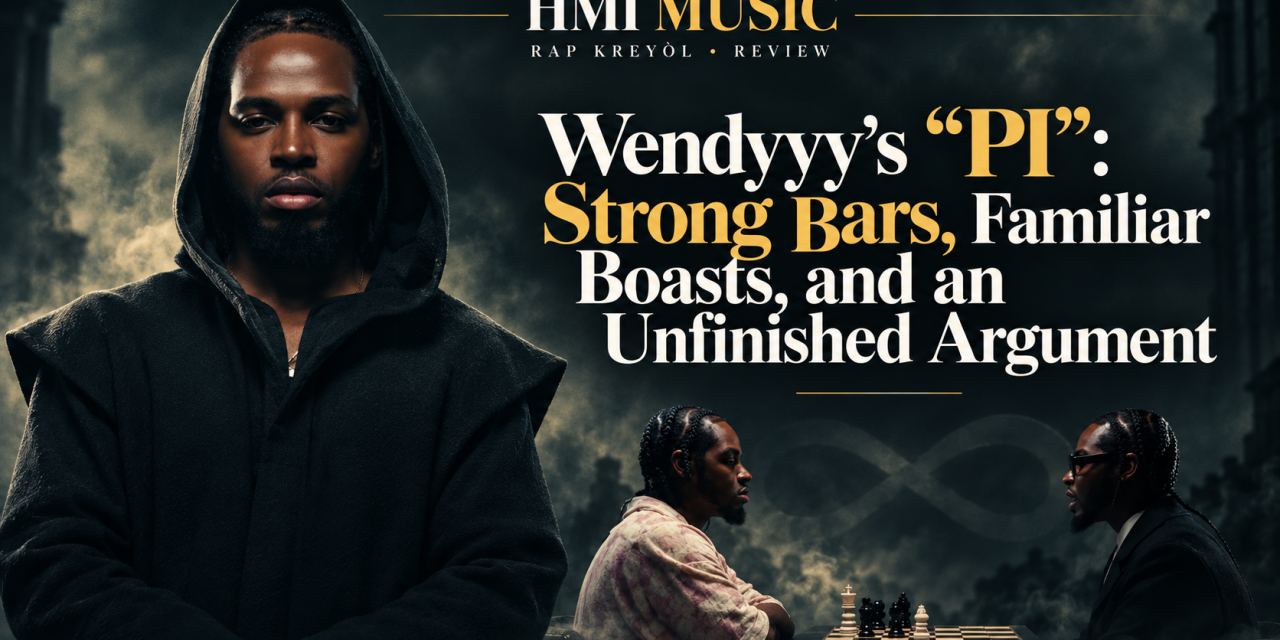
The writing projects independence and lyrical authority. But its sharpest wordplay does more work than its ideas—and the promise of greatness sometimes outruns the evidence inside the verse.
Review scope: This is a lyrics-only assessment of the transcription supplied for “PI.” It evaluates writing, thematic development, and the rhythmic possibilities suggested by the words. It does not rate the recording’s beat, audible flow, vocal delivery, mixing, or mastering.
Wendyyy opens “PI” by establishing a hierarchy: another person’s dream is already his reality. That is a strong opening for a competitive rap record. It announces ambition without needing a long introduction, and its reversal gives the listener a compact line to remember. The problem is what follows: much of the verse keeps restating that superiority rather than developing a more revealing argument for it.
As writing, “PI” has personality, rhyme awareness, and several effective turns of phrase. It also leans heavily on recognizable battle-rap material: imitators, hostile competitors, divine protection, sexual dominance, and an anticipated downfall that never arrives. Familiar subjects can produce excellent rap. Here, however, the strongest moments are often the verbal connections between those subjects, rather than the subjects themselves.
Flow on the page: strong rhyme pockets, uneven density
The opening builds a useful sequence around “dream,” “entrodwi m,” “repwodwi m,” and “pwodwi m.” These are approximate sound relationships rather than identical rhymes, but they give the passage continuity. More significantly, introduction, imitation, and creation become linked ideas: Wendyyy presents himself, says others reproduce him, and then credits God with producing him. That connection gives the rhyme more purpose than a list of matching endings.
The church passage offers another effective pocket. Pastor, faithful followers, and tithes connect artistic authority, fandom, and money. The vocabulary suggests a coherent metaphor that could carry a larger section. Wendyyy moves away from it quickly, though, choosing another assertion of greatness instead of exploring what that relationship with his audience means.
The text also shifts between short declarations and longer, crowded sentences. That creates opportunities for changes in cadence, but opportunities are not proof of execution. A rapper can make a dense line work through pauses, compression, or deliberate displacement against the beat. Without an audio-based assessment, it would be unfair to call those lines off-beat—or to praise their breath control. The defensible criticism is structural: some passages are more economical and immediately legible than others.
Delivery: the persona is clear; the performance remains ungraded
The language implies a confrontational performance, with commands, questions, warnings, and direct challenges. Wendyyy writes as someone who expects the room to acknowledge his authority. The repeated address to opponents supplies a clear rhetorical stance.
But written confidence and convincing vocal delivery are separate achievements. Tone, emphasis, timing, articulation, and the relationship between voice and instrumental determine whether a boast sounds commanding, playful, or merely loud. None receives a score here. On the page, the limitation is that confrontation dominates the emotional range: the verse repeatedly tells us he is independent, underestimated, and superior, while giving relatively little space to uncertainty or reflection.
Lyricism: the best bars connect ideas, not just sounds
The line about sixteen years of independence is one of the verse’s strongest personal anchors. It is an autobiographical claim within the song, not a career history independently verified for this review. Its lyrical value lies in the connection between independence and freedom of expression: no boss can tell him to lower his voice. That is a more meaningful statement than an unspecified claim to be better than everyone else.
The switch between Haitian Creole, French, and English also provides verbal flexibility. Code-switching itself is not a measure of technical excellence; its value depends on what it achieves. The French writing imagery involving dots on letters and bars across letters ties control of language to a claim that everything is proceeding according to plan. That is a thoughtful connection, although the claim remains broad.
The closing “atansyon” sequence is particularly effective. It moves through warning, visibility, and attentiveness, ending with the idea that others will receive no attention because they failed to pay attention. Repetition becomes a mechanism for changing meaning. The ending gains force from that semantic movement, rather than from repetition alone.
By contrast, the “sa,” “ka sa,” and “eta sa” passage may contain phrasing or pronunciation that makes more sense in performance. Even with that caveat, it illustrates a risk in this writing: a chain of similar sounds can become more prominent than the proposition those sounds are meant to express.
Content: independence has substance; supremacy needs development
“Tout rap kreyol ap repwodwi m” is the verse’s most sweeping assertion. As competitive exaggeration, it is legitimate rap language. As an argument about artistic influence, it is unsupported inside the text. Which techniques, approaches, or ideas are supposedly being copied? The verse supplies the accusation, but few specifics that would make it distinctive.
The mixture of faith and aggression is more interesting. Wendyyy invokes divine creation and protection while presenting himself as combative and sexually dominant. That tension could reveal a complicated persona. Here, the spiritual language mostly functions as an endorsement of his greatness, rather than an examination of responsibility, contradiction, or belief.
The explicit sexual boast is the weakest thematic detour. It seeks shock and dominance, but reduces a woman to a prop in the speaker’s self-celebration. The named cultural references surrounding it may carry additional meaning, yet without clearer context they cannot simply be awarded points for cleverness. The passage adds provocation more readily than insight.
Likewise, the reference to a new penal code introduces the possibility of a broader social or political angle, then returns to a warning about choosing the wrong side. It is a striking image without much development. “PI” repeatedly approaches richer subjects—independence, influence, faith, power—then retreats to the safety of declaring victory.
Structure: accumulation does not always create progression
In the supplied text, the verse progresses through self-introduction, career pride, provocation, warnings, divine backing, and a final rebuke. That sequence has movement, but limited transformation. The speaker’s position at the end is essentially the position established at the start: he is ahead, his opponents misunderstand him, and his success is assured.
A boast record does not need a conventional story or a moral lesson. It does need escalation, surprise, or enough fresh imagery to make each new claim feel necessary. “PI” achieves that in particular rhyme pockets, but not consistently across the whole transcription. Its larger claims would hit harder with fewer repetitions and more concrete detail.
Lyrics-only scorecard
| Category | Score | Assessment |
|---|---|---|
| Wordplay and rhyme construction | 8/10 | Effective linked vocabulary and a strong attention-based closing sequence. |
| Rhythmic writing potential | 7/10 | Clear rhyme pockets, with uneven line density; audible flow is not graded. |
| Content and thematic development | 6/10 | Meaningful independence theme, diluted by familiar supremacy claims. |
| Structure and cohesion | 6/10 | A recognizable progression, but limited development between opening and conclusion. |
| Originality and specificity | 7/10 | A distinct verbal persona, with too many broad claims and too few concrete examples. |
| Overall: equal-weight average | 6.8/10 | Lyrics only; delivery and production excluded. |
Verdict: good writing in places, less convincing as a complete statement
“PI” demonstrates verbal skill more convincingly than it establishes the total dominance its speaker claims. Its best moments connect sound, meaning, and personality; its weaker moments rely on provocation or repeat an already clear message of superiority.
Rating: 6.8/10, based on lyrics alone. A capable competitive verse with memorable devices, but insufficient thematic development to qualify as exceptional writing. Wendyyy has written bars worth discussing. The text would become stronger if it spent less time announcing his stature and more time making that stature unmistakable.