

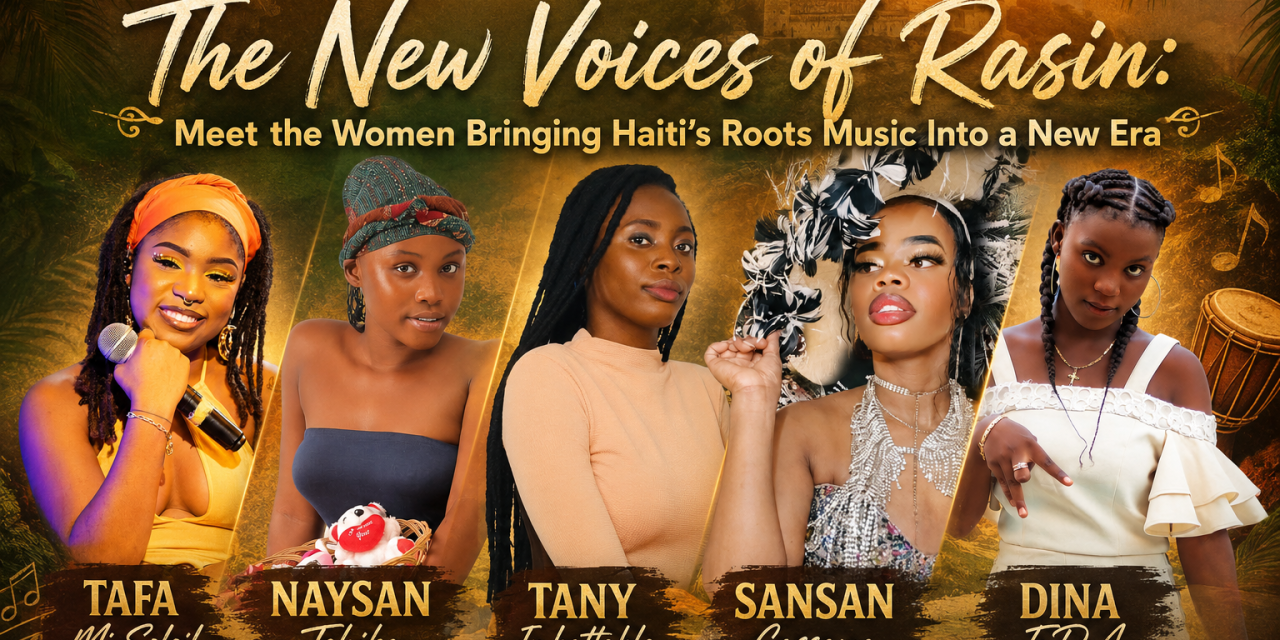
Tafa Mi-Soleil. Naysan Tchika. Dina FDA. Tany Imbattable. Sansan Cassama. Five names, one current running through them: a generation of Haitian women pulling rasin’s Vodou-rooted sound into 2026.
📌 THE MOMENT
Mizik rasin — Haiti’s roots music movement, born in the late 1980s and early ’90s out of groups like Boukman Eksperyans, RAM, and Boukan Ginen — has always drawn its power from a specific well: Vodou ceremonial rhythms, rara horns, ancestral storytelling, and lyrics that speak in the coded, poetic language of Haitian resistance. For decades, the movement’s most visible voices were largely male-fronted bands, even as women like Mimerose “Manzè” Beaubrun and Lunise Morse anchored some of its most iconic groups from within.
Today, a newer generation of women — working more independently, more digitally, and often blending rasin’s sacred sound with contemporary production — is pushing that tradition forward. Here’s where each of them actually stands.
🌟 TAFA MI-SOLEIL — THE ESTABLISHED RISING STAR
Of the five names in this piece, Tafa Mi-Soleil (born Evenie Rose Thafaïna Saint-Louis, March 17, 1998, in Fort Jacques) has the fullest, most documented career. A singer, stylist, and painter, she broke through publicly in 2021 with collaborations like “Mizik Sove Vi M” alongside rapper D-fi, and has released two EPs — Reponn (2021) and Phoenix (2023) — the latter explicitly built around revalorizing rasin music, blended with electronic textures and Afrobeat influences.
Her song “Lakou” — a defense of Vodou as living Haitian cultural heritage, exploring the healing use of plants and ritual — became one of the most talked-about Haitian tracks of 2023, landing in the top three hits of the year according to several major Haitian outlets and later appearing on the Putumayo compilation Global Groove 4. That same year, she won Best Female Artist of the Year at the Haitian Music Awards and Best Female Variety Artist and Best EP of the Year from Haiti’s Ticket Magazine. She’s also been recognized internationally, participating in the U.S. State Department’s International Visitor Leadership Program focused on social change through music.
Tafa isn’t a rasin purist in the traditional band sense — her sound moves fluidly between soul, pop-rock, electronic, and Afrobeat — but her explicit mission to “revalorize” rasin roots, paired with real commercial and critical success, makes her arguably the most visible bridge between the genre’s ceremonial past and its pop-adjacent future.
🥁 SANSAN CASSAMA — THE MOST DIRECTLY VODOU-ROOTED SOUND
Sansan Cassama stands out among this group for how directly her music engages Vodou tradition. Tracks like “Bitasyon” (tagged explicitly by the artist as rasin, Vodou, and folklore) and “Baron Se Nonm Mwen” — a title invoking Baron Samedi, one of Vodou’s most recognizable lwa — place her sound close to rasin’s ceremonial roots, and her growing presence on platforms like TikTok has made her part of a wider wave of Vodou-themed music content reaching younger, largely diaspora-connected audiences.
🎤 DINA FDA — RASIN THEMES THROUGH A MODERN LENS
Dina FDA has been active with a steady stream of 2025–2026 singles, including “Rele Ginen Yo” — a title that explicitly invokes Ginen, the ancestral spiritual homeland referenced throughout Haitian Vodou cosmology and rasin lyricism — alongside tracks like “Kay La Manbo,” referencing a Vodou priestess’s house. Her catalog moves between rasin-adjacent, spiritually rooted material and more contemporary collaborative singles, positioning her as part of the same emerging scene without being confined to a single lane.
🔎 NAYSAN TCHIKA & TANY IMBATTABLE — NAMES ON THE RISE, RECORDS STILL FILLING IN
Here’s where we have to be straightforward with readers: Naysan Tchika and Tany Imbattable are real, active names circulating within this same social-media-driven wave of young Haitian artists — both appear alongside Sansan Cassama, Dina FDA, and others in “similar artists” listings tied to Haiti’s Vodou/rasin-adjacent music scene on platforms like Shazam. Naysan Tchika has released tracks and collaborations (including one featuring Tafa Mi-Soleil), though available material leans toward a broader mix of styles rather than a clearly defined rasin catalog. Beyond that surface-level presence, detailed, independently verifiable biographical information on both artists is limited at this time — a reminder that this scene is still young enough that press coverage hasn’t fully caught up to it.
🌍 THE BIGGER PICTURE
What connects these five names isn’t a shared sound so much as a shared instinct: reaching back into Vodou ceremonial music, rara rhythms, and Ginen cosmology — the same well Boukman Eksperyans and RAM drew from three decades ago — and reworking it through today’s production tools and today’s platforms. Where ’90s rasin built its audience through carnival, live bands, and physical albums, this generation is building theirs through EPs, singles, and short-form video, often with far less institutional backing behind them.
Whether all five ultimately become defining voices of rasin’s next chapter or whether some remain more peripheral to the genre than others, the direction is clear: rasin’s ceremonial roots are being carried forward by young Haitian women who didn’t inherit a band — they’re building their own platform, one release at a time.
HMI Music will continue tracking this scene as new releases and information become available.
#RasinMizik #HaitianMusic #TafaMiSoleil #SansanCassama #DinaFDA #HMIMusic