
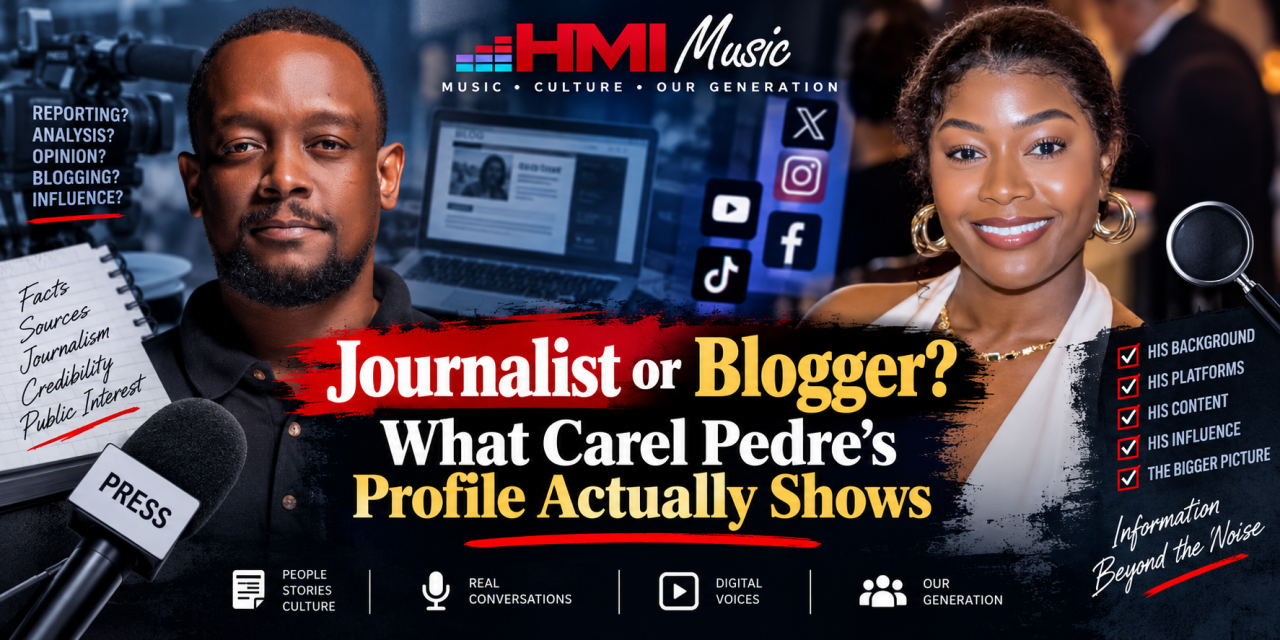
Carel Pedre is one of the most recognizable Haitian names in media, with a combined social following in the millions and a career spanning more than two decades. His LinkedIn profile describes him as a “Radio & TV Host · Media Entrepreneur · Founder of Chokarella Media,” with top skills listed as “Video Production · Scriptwriting · Emcee · Broadcasting · Digital Media.” Notably, the word “journalist” does not appear in his own self-description — which raises a fair question worth examining on its own terms: is Carel Pedre a journalist, a media entrepreneur, an influencer, or some combination of the three? And what does it actually take to be considered a journalist in the first place?
What Does It Actually Take to Be a Journalist?
Before evaluating Pedre specifically, it’s worth correcting a common misconception baked into how this question usually gets asked: in most of the world, including Haiti, the United States, and the vast majority of democracies, journalism is not a licensed or credentialed profession. There is no government-issued journalism license, no bar exam, and no universally required degree. Unlike law or medicine, anyone can legally call themselves a journalist and practice journalism without formal training — a fact press freedom advocates generally defend, since state-controlled licensing of journalists has historically been a tool for restricting a free press, not protecting it.
That said, professional norms — as opposed to legal requirements — do shape how the field distinguishes journalism from other forms of media work. Most journalism educators and professional associations point to a cluster of practices, rather than credentials, as the real test:
- Verification: Checking facts and sourcing claims before publishing, rather than repeating unverified information.
- Editorial independence: Reporting without being controlled by the subjects being covered, advertisers, or political sponsors.
- Public-interest purpose: Producing work primarily to inform the public, rather than primarily to entertain or promote a brand or product.
- Accountability: Issuing corrections, being answerable to editorial standards, and distinguishing reported fact from opinion or promotion.
A journalism degree can help someone learn these practices, but it does not define whether someone is doing journalism — plenty of credentialed journalism-school graduates work exclusively in public relations or entertainment, while plenty of self-taught reporters, particularly in crisis and disaster reporting, are widely recognized as having done real journalistic work.
Correcting the Premise: Pedre’s Educational Background
It’s worth addressing directly: public biographical records list Pedre as having attended the École Supérieure d’Infotronique d’Haïti, a Haitian institution focused on computer science and electronics — so the claim that he “never went to school” isn’t accurate. What is fair to say is that his formal education was not in journalism specifically; his radio and television career, by most published accounts, developed through on-the-job experience in Haitian radio starting in the early-to-mid 2000s rather than through a journalism degree program.
What Pedre’s Actual Career Shows
Pedre’s public record is genuinely mixed, and that mix is exactly what makes the “journalist vs. blogger” question interesting rather than a simple yes-or-no.
The case that he has done real journalistic work: During the January 2010 earthquake, when Haiti was cut off from most communications, Pedre used a scarce internet connection to relay real-time information about the disaster to international media and aid organizations. CNN described his social media feed at the time as a clearinghouse for aid agencies working the crisis. That kind of on-the-ground, real-time public-interest reporting during a communications blackout is, functionally, breaking-news journalism — regardless of what credential he held at the time. He has since been invited to speak at Harvard’s Kennedy School of Government and delivered a TEDx talk specifically about Haiti’s post-earthquake resilience, engagements typically extended to people recognized for substantive public-interest contributions, not purely for entertainment reach.
The case that his primary identity is entrepreneurial and entertainment-driven: The bulk of Pedre’s television and radio résumé — Digicel Stars (a talent competition), Kiyès Ki Towo? (a Shark Tank-style entrepreneurship show), and his flagship morning program Chokarella — sits squarely in entertainment and lifestyle broadcasting rather than news reporting. His own professional self-description leads with “Media Entrepreneur,” and he describes his current work as producing original content, building brand partnerships (with companies like Digicel, Prestige Beer, Sogebank, and Toyota Haiti), and developing software and digital platforms — commercial and entrepreneurial activity, not editorial reporting.
So Which Is It?
The honest answer is that Pedre doesn’t fit neatly into either box, and that’s increasingly common in modern media rather than exceptional. He has functioned as a journalist in specific, notable moments — most importantly during the 2010 earthquake — while building a career and brand primarily around entertainment hosting, talent competitions, and commercial media entrepreneurship. Multiple outlets covering him, including the Haitian Times and Florida International University’s Caplin News, still refer to him as a “journalist” in their own reporting, while his own professional materials increasingly favor “media personality” and “entrepreneur.”
Rather than a disqualifying gap, the more accurate description is that Pedre represents a hybrid figure typical of the social media era: someone whose reach and credibility were built through broadcast entertainment and personal brand-building, who has at points also performed a genuine journalistic function — particularly under crisis conditions — without that function being the primary throughline of his career. Calling him “only a blogger” undersells the real, internationally recognized reporting role he played in 2010. Calling him a journalist without qualification overlooks that the great majority of his current work is openly commercial, brand-partnered, and entertainment-focused rather than editorial.
This article draws on public biographical sources, published interviews, and Pedre’s own professional profile.


