

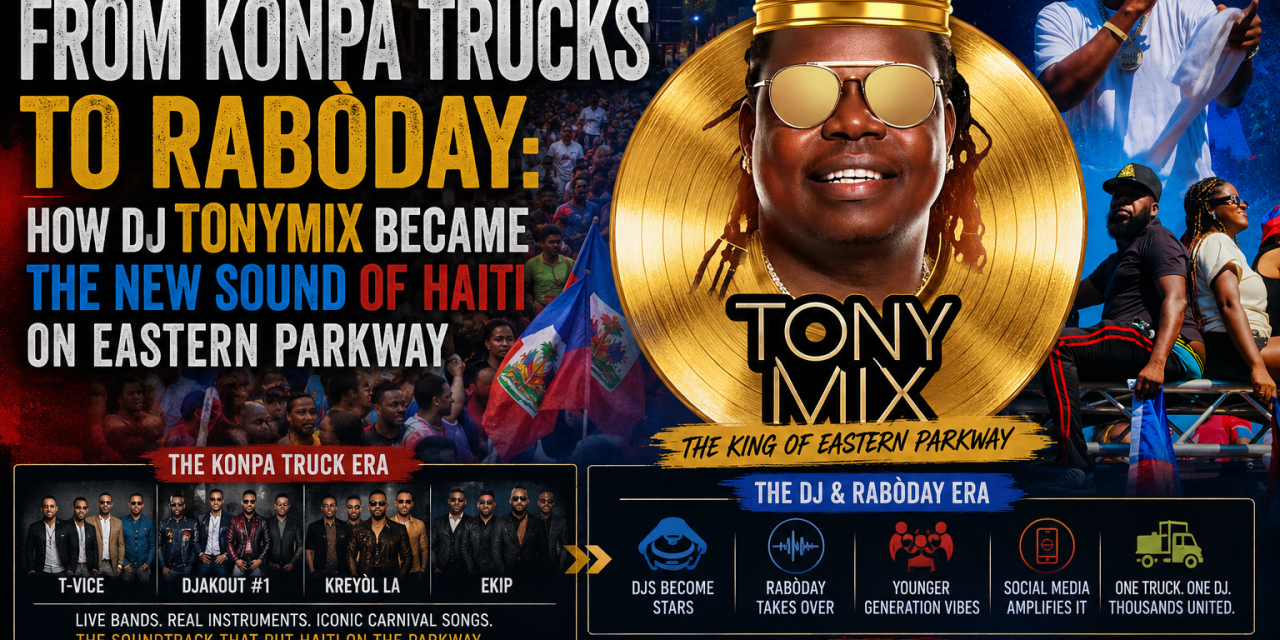
For years, Haiti’s presence at New York’s Labor Day Carnival was identified with the thunder of live konpa bands—T-Vice, Djakout, Kreyòl La and others turning enormous music trucks into moving concerts. Then the center of gravity began to shift. DJs became stars, rabòday became a soundtrack for a younger generation, and TonyMix emerged as one of the most visible symbols of that transformation. Calling him the “King of Eastern Parkway” is ultimately a cultural judgment, not an official title—but there is a serious argument behind it.
By HMI Music | September 3, 2026
There was a time when asking which Haitian act would dominate Eastern Parkway on Labor Day meant asking a very different question:
Which konpa band has the biggest truck?
Was it T-Vice?
Was it Djakout?
Was it Kreyòl La?
Which band had the hottest kanaval song?
Which truck would attract the largest Haitian crowd?
Which musicians could keep thousands of people moving while their enormous mobile sound system crawled through Brooklyn?
For a generation of Haitian music fans, this was part of the ritual of Labor Day weekend in New York.
But Haitian popular culture does not stand still.
The Eastern Parkway of the 2000s is not the Eastern Parkway of the 2020s.
The audience changed.
The technology changed.
The music changed.
And perhaps most importantly, the DJ changed.
The DJ was no longer simply the person playing records between live performances.
The DJ became the performance.
And few Haitian DJs represent that transformation more clearly than TonyMix.
Today, the argument can legitimately be made that when Haitians think about the contemporary Haitian music-truck experience on Eastern Parkway, TonyMix—not a traditional konpa band—has become one of its defining figures.
In the language of popular culture:
TonyMix has become the King of Haiti’s modern Eastern Parkway sound.
Not because someone officially crowned him.
Because the music underneath the crown changed.
Before TonyMix, There Was the Konpa Truck
To understand TonyMix’s rise, we first have to give the previous generation its credit.
The West Indian American Day Carnival is much older and much broader than Haiti’s participation in it. The celebration developed from Caribbean carnival traditions in New York and eventually established its famous Brooklyn procession along Eastern Parkway. The 2026 edition is the 59th anniversary of the New York Carnival organized by the West Indian American Day Carnival Association, and organizers expect more than a million participants and spectators.
Eastern Parkway is not a Haitian parade.
It is a massive Caribbean cultural space.
Trinidadian carnival traditions—mas, steel pan, calypso and later soca—are fundamental to its history. Today the parade incorporates flags, music and communities representing Haiti, Jamaica, Barbados, Dominica, Saint Lucia, Guyana, Suriname, Belize and many others.
Haitians nevertheless developed their own distinctive presence within that ecosystem.
And music became one of the principal ways they did it.
The Haitian innovation was straightforward but powerful:
Put the band on the truck.
Bring the sound system.
Bring the singers.
Bring the musicians.
Bring the flags.
Bring the fans.
And turn Eastern Parkway into a moving Haitian concert.
T-Vice Helped Define an Era
Any serious history of Haitian music on Eastern Parkway has to acknowledge T-Vice.
The band’s mixture of konpa, carnival music, electronic production and high-energy performance made it particularly suited to Labor Day.
T-Vice understood something fundamental about the Parkway:
A song that works beautifully at 1 a.m. inside a ballroom does not necessarily work the same way at 2 p.m. in the middle of thousands of people walking down a Brooklyn avenue.
Eastern Parkway demands energy.
It demands repetition.
It demands bass.
It demands hooks that people can recognize immediately.
It demands music capable of moving a crowd that may not even be standing directly beside the truck.
T-Vice’s carnival-oriented catalog fit that environment.
For many Haitian fans, Labor Day therefore became almost inseparable from the annual competition between major Haitian bands.
Then Came Djakout
If T-Vice represented one pole of that competition, Djakout Mizik—and later Djakout #1—represented another.
Djakout brought a different kind of force.
Live percussion.
Heavy bass.
Horns.
Vocals.
Musicianship.
A large ensemble capable of making a truck feel like an outdoor concert stage.
The rivalry between bands wasn’t merely musical.
Fans carried allegiances.
People chose trucks.
Arguments continued afterward about which band had the bigger crowd, better performance or stronger carnival song.
That competition helped create an extraordinary period for Haitian music in New York.
Kreyòl La Continued the Tradition
Kreyòl La also became part of this landscape.
The group brought another established HMI audience into Labor Day culture and helped reinforce the idea that Eastern Parkway was not merely somewhere Haitian artists occasionally performed.
It was somewhere Haitian music needed to be represented.
That distinction matters.
For Haitian immigrants and their children, seeing a major Haitian band surrounded by Haitian flags in the middle of one of America’s largest Caribbean celebrations carried symbolic importance.
Haiti was visible.
Haitian Creole was audible.
Konpa was competing for space against soca and dancehall.
The truck was therefore more than entertainment.
It was a moving declaration:
Nou la tou.
We are here too.
But Something Changed
Eventually, another sound began challenging konpa’s control over that Haitian space.
Rabòday.
The transformation did not happen overnight, and it cannot honestly be credited to one person.
Rabòday itself has deeper Haitian roots and multiple musical architects. Its development involves DJs, producers, bands, rara-derived rhythmic ideas, electronic production and Haiti’s broader evolution toward digitally driven dance music.
But on Eastern Parkway, rabòday possessed several characteristics that made it almost perfectly designed for the environment.
It is immediate.
It is rhythmic.
It is repetitive.
It can be aggressive.
It encourages collective movement.
A DJ can manipulate it continuously.
And perhaps most importantly:
You don’t need an entire konpa band to deliver it.
That changed the economics and the mechanics of the Haitian truck.
The DJ Becomes the Band
Think about the difference.
A major konpa group may require a singer, guitarist, bassist, keyboardists, drummer, percussionists, background vocalists, sound engineers, instruments, stage equipment and rehearsals.
Then all of that has to function on a moving platform.
A DJ needs a fundamentally different infrastructure.
Turntables or controllers.
A mixer.
A computer.
Microphones.
A powerful sound system.
And the right person controlling the crowd.
That doesn’t make DJ performance artistically superior to live musicianship.
It makes it different—and extraordinarily efficient for a street carnival.
Once DJs became personalities powerful enough to draw crowds on their own, the old relationship changed.
The question stopped being:
“Ki gwoup ki sou cha a?”
It could now be:
“Ki DJ ki sou cha a?”
And that is where TonyMix becomes historically important.
TonyMix Didn’t Just Play Rabòday—He Helped Sell the Experience
TonyMix’s strength is not simply selecting songs.
His public persona is part of the performance.
The microphone matters.
His timing matters.
His relationship with the crowd matters.
His ability to move between Haitian genres matters.
And the visual spectacle surrounding the truck matters.
The photographs of his Eastern Parkway appearances tell part of that story: TonyMix standing high above the crowd with microphone in hand, Haitian flags surrounding the platform and revelers dancing around him.
That is not the visual language of the traditional nightclub DJ hidden behind a booth.
It resembles a frontman.
Except the instrument is the entire sound system.
Rabòday Was Built for This Moment
Konpa asks the body to dance.
Rabòday can command the body to move.
That distinction becomes especially powerful outdoors.
Eastern Parkway is not a traditional konpa dance floor where couples necessarily have room to execute detailed partner dancing.
It is crowded.
People are walking.
Jumping.
Waving flags.
Recording videos.
Shouting.
Following trucks.
Rabòday works exceptionally well in that environment because participation does not require formal partner dancing.
The crowd itself becomes choreography.
A rhythmic instruction can travel through hundreds of people almost instantaneously.
The DJ can stop the beat.
Talk to the crowd.
Restart it.
Switch tracks.
Drop a carnival record.
Move into hip-hop.
Return to rabòday.
Throw in konpa.
Introduce a chant.
The musical architecture becomes flexible.
That flexibility is enormously powerful in a parade.
Social Media Changed Eastern Parkway Too
There is another difference between the T-Vice/Djakout era and the TonyMix era.
The smartphone.
An Eastern Parkway performance once primarily existed for the people physically standing there.
Now every dramatic moment can become content.
Someone climbs the truck.
A Haitian flag waves behind TonyMix.
The beat drops.
Thousands jump.
Someone records fifteen seconds.
Within minutes it can appear on Instagram.
TikTok.
Facebook.
YouTube.
WhatsApp.
The truck is therefore no longer performing only for Eastern Parkway.
It is performing simultaneously for the Haitian internet.
A DJ-centered spectacle adapts naturally to that environment.
TonyMix himself becomes a recognizable visual anchor.
People don’t need to identify seven musicians.
They see TonyMix.
They see the flag.
They hear the beat.
They understand the moment.
The Haitian-American Audience Changed
There is also a generational dimension.
The children of the great Haitian migration waves are not culturally identical to their parents.
Many younger Haitian Americans move effortlessly between:
Konpa.
Rabòday.
Hip-hop.
Afrobeats.
Dancehall.
Soca.
R&B.
Drill.
Their playlists do not necessarily respect the rigid genre boundaries that once structured Haitian radio.
TonyMix fits that audience extremely well.
The DJ can move across genres without requiring the crowd to leave.
That makes the truck culturally bilingual—or even multilingual.
It can sound Haitian one minute, Caribbean the next and New York immediately afterward.
That is precisely what Eastern Parkway itself represents.
Does That Mean Konpa Is Dead on Eastern Parkway?
Absolutely not.
That conclusion would go too far.
Konpa remains one of Haiti’s foundational popular musical traditions.
T-Vice remains culturally important.
Kreyòl La remains important.
Djakout’s legacy remains important.
Ekip represents another generation of Haitian band music.
And thousands of Haitians still want to hear live konpa.
The more defensible conclusion is different:
Konpa no longer appears to possess an uncontested monopoly over the Haitian sound of Eastern Parkway.
That is a major cultural shift.
The traditional bands once functioned as the principal magnets around which Haitian Labor Day audiences gathered.
Increasingly, the DJ and rabòday have demonstrated that they can generate comparable cultural energy without reproducing the old band model.
That is not the death of konpa.
It is the fragmentation of konpa’s dominance.
And 2026 Makes the Transformation Even More Visible
This year’s circumstances make the historical contrast remarkable.
TonyMix has officially announced that he will not participate in the 2026 New York Labor Day Carnival on Eastern Parkway. His statement thanks fans, supporters, partners and the Haitian community but does not state why he is sitting this year out.
HMI Music also has not located comparable official announcements establishing that T-Vice, Kreyòl La, Ekip or Djakout #1 will return with the type of Haitian music trucks traditionally associated with the Parkway this year.
That means something fascinating has happened.
TonyMix’s absence itself has become news.
Think about what that says.
A generation ago, the big question might have been:
Where is T-Vice?
Or:
Where is Djakout?
Today we are asking:
Where is TonyMix?
That change in the question tells part of the history.
Is TonyMix Really the “King of Eastern Parkway”?
There is no official King of Eastern Parkway.
WIADCA does not award that title.
No objective attendance measurement establishes that TonyMix has attracted more Haitian followers than every band or DJ across every year.
And HMI Music should not transform fan language into a historical fact.
But as a cultural argument, the title has meaning.
A king in popular music is rarely selected by committee.
The title usually emerges because an artist becomes associated with a particular stage, city, sound or era.
And TonyMix has a credible claim to being one of the defining Haitian figures of the recent Eastern Parkway era precisely because he represents the transition from the band-centered Haitian carnival truck to the DJ-centered Haitian carnival experience.
That is bigger than popularity.
It represents structural change.
The Crown Actually Belongs to the Crowd
There is another reason TonyMix’s rise matters.
He did not make rabòday dominant by himself.
The audience chose it.
DJs can push records.
Promoters can advertise artists.
Radio can create exposure.
Social media can manufacture hype.
But none of that forces thousands of people to respond physically to a rhythm.
Eastern Parkway is a brutal test because the audience can simply walk away.
There are other trucks.
Other countries.
Other sounds.
Other DJs.
Other bands.
Soca is everywhere.
Dancehall is nearby.
Steel pan is part of the carnival’s foundation.
If a Haitian truck cannot hold its crowd, people have alternatives.
The rise of rabòday therefore says something about the Haitian audience itself.
They wanted the energy.
From Guitar Solo to Beat Drop
That may be the simplest way to understand the transition.
The previous era celebrated the band.
The new era increasingly celebrates the moment.
The old climax might have been a guitar solo.
The new climax can be a beat drop.
The old competition was between bands.
The new competition is between sounds.
The old frontman stood beside six or eight musicians.
The modern DJ can stand alone behind the system and command thousands.
Neither form is inherently superior.
They simply represent different periods in Haitian popular culture.
TonyMix Is a Symbol of a Larger Revolution
This is why TonyMix’s importance should not be reduced to:
“He is a popular DJ.”
His Eastern Parkway presence represents something larger.
He sits at the intersection of:
Haitian immigration.
Brooklyn street culture.
Digital music.
Rabòday.
Social media.
DJ celebrity.
Diaspora identity.
Carnival culture.
And the declining necessity of the traditional live-band structure for mass Haitian street entertainment.
That combination helps explain why a DJ could eventually occupy cultural territory once largely controlled by some of Haiti’s biggest konpa bands.
T-Vice, Kreyòl La, Ekip and Djakout Are Not the Losers
It would also be wrong to turn this history into a disrespectful competition.
TonyMix’s rise does not erase what those bands built.
In fact, without the Haitian music-truck culture developed and popularized through earlier generations of bands, there might not have been the same platform for DJs to inherit.
T-Vice helped build the audience.
Djakout helped build it.
Kreyòl La helped build it.
Other Haitian artists, promoters, DJs and community organizations helped build it.
TonyMix entered an ecosystem created over decades.
What he represents is its next evolution.
The Most Important Change Is Not TonyMix
It is the audience behind him.
Look carefully at the images from his Parkway appearances.
The Haitian flags remain.
The pride remains.
The dancing remains.
The truck remains.
The enormous speakers remain.
The desire to claim space in Brooklyn remains.
What changed is the soundtrack.
That is how culture normally evolves.
It rarely announces:
“The old era has ended.”
Instead, one year you suddenly realize the crowd is following a different truck.
From Konpa to Rabòday
For years, Haitian bands brought konpa to Eastern Parkway and demonstrated that Haiti deserved space inside New York’s enormous Caribbean celebration.
Today, DJs are carrying that visibility forward in another form.
And TonyMix has become one of the clearest symbols of that transition.
So perhaps the historical argument should not be:
TonyMix defeated T-Vice, Kreyòl La, Djakout or Ekip.
That misses the point.
The better argument is:
TonyMix inherited the street they helped build—and changed its soundtrack.
T-Vice represents an era.
Djakout represents an era.
Kreyòl La represents an era.
The Haitian konpa truck represents an era.
But the rise of TonyMix demonstrates that Eastern Parkway’s Haitian crowd no longer requires a full konpa band to generate a massive cultural moment.
Give them a truck.
Give them a powerful system.
Give them Haitian flags.
Give them a DJ who understands the crowd.
And give them rabòday.
The Parkway can explode.
THE KING WITHOUT A TRUCK IN 2026
And that makes TonyMix’s 2026 announcement unusually symbolic.
The West Indian Day Parade will return Monday, September 7, traveling along Eastern Parkway, with the broader celebration expected to attract more than a million people.
But TonyMix says he won’t be there.
For HMI Music, that absence provides an unexpected measurement of his importance.
Twenty years ago, would the absence of a DJ have created the same conversation among Haitian Labor Day followers?
That question may tell us everything.
The history of Haitian participation on Eastern Parkway can increasingly be read in two broad musical chapters:
THE KONPA-TRUCK ERA
T-Vice. Djakout. Kreyòl La. Live musicians. Carnival songs. Band rivalries.
Then:
THE DJ/RABÒDAY ERA
TonyMix. Digital production. Beat drops. Crowd commands. Viral videos. A new generation.
One did not completely replace the other.
But the balance of cultural power changed.
And if fans want to call TonyMix the “King of New York Labor Day Carnival on Eastern Parkway,” the strongest argument for that crown isn’t that he destroyed konpa.
It’s that he became the face of what came after konpa stopped being the only Haitian sound powerful enough to rule the truck.
Konpa built the road.
Rabòday changed the traffic.
And TonyMix learned how to drive it.
HMI Music — Haitian Music. Culture. History. Analysis.


