

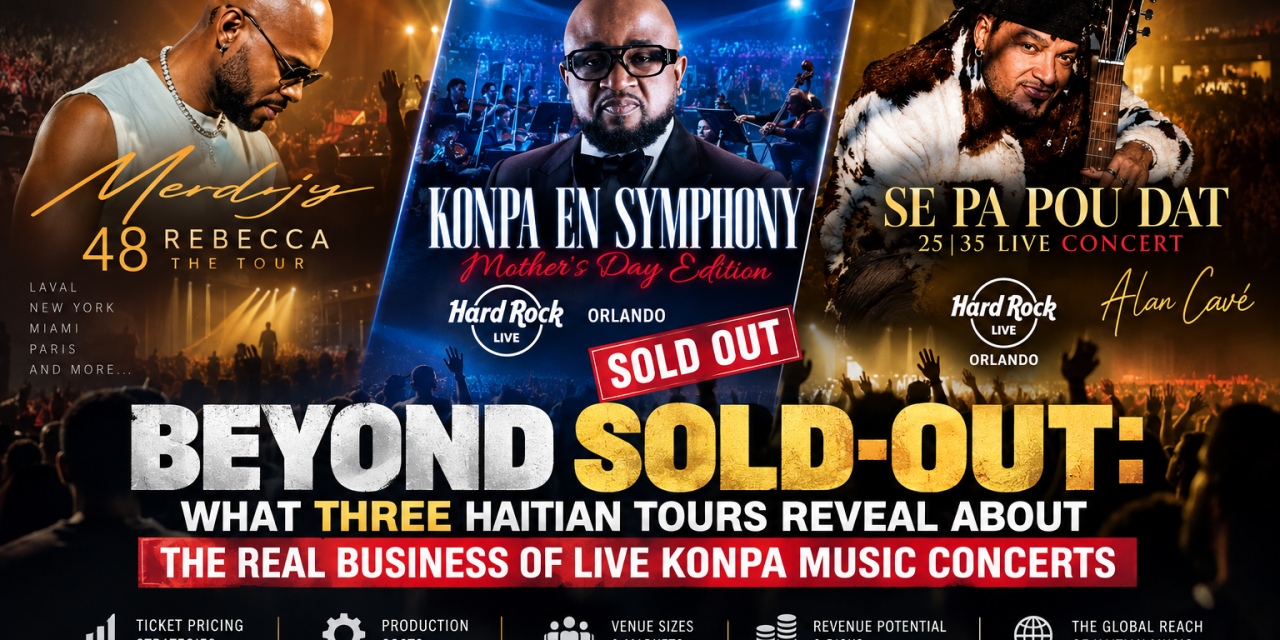
Note on methodology: exact deal terms (guarantees, backend splits, production budgets) for these tours are private and not publicly disclosed. What follows is a financial model built from what’s verifiable — venue capacities, published price points, promoter identities, and marketing signals visible on the tour material itself — mapped against standard live-music industry economics. Treat the dollar figures as informed estimates, not confirmed financials.
Three very different business models are on display here: Medjy’s “48 Rebecca” tour, Alan Cavé’s “Se Pa Pou Dat 25|35” tour, and Arly Lariviere’s “Konpa en Symphony.” All three are Haitian-market touring acts, but they’re running fundamentally different economic playbooks — and that difference is the whole story.
Pillar 1: Promoter vs. Artist Risk Distribution
Medjy and Alan Cavé are running the standard mid-scale touring model: single-artist, single-band shows at 3,000–6,000-capacity theaters (MGM Music Hall at Fenway, James L. Knight Center, Hard Rock Live at Universal Orlando, Dome de Paris). This is the lowest-risk structure in live music. A promoter (Ticketmaster-affiliated venues suggest a traditional promoter-guarantee deal) typically fronts an artist guarantee plus a percentage of net after break-even, and the artist’s exposure is largely capped — their downside is a lighter guarantee if the show underperforms, not a balance-sheet loss. Production costs (band, sound, lights) are modest and scale predictably with venue size.
Arly Lariviere’s “Konpa en Symphony” is a different animal entirely. This isn’t a band show — it’s a full orchestral production (strings section, conductor, formal staging) booked into venues ranging from a 5,600-seat Broadway-style theater (The Theater at Madison Square Garden) up to an NBA arena, where Kaseya Center’s concert capacity flexes between 5,000 and roughly 20,000 depending on staging configuration. That’s a radically different risk profile. An orchestra isn’t a fixed low-overhead cost — it’s dozens of unionized or contracted musicians, extensive rehearsal time, and a production budget that doesn’t shrink much even if ticket sales do. When Arly (or his promoter, Nulook Music/Live Nation, per the Kaseya Center bill) commits to that scale of venue and that scale of production simultaneously, the artist side is almost certainly carrying a much larger guarantee or co-promotion risk than Medjy or Alan Cavé ever touch.
This is the central financial tension of the “Konpa en Symphony” brand: it’s positioned as a premium, orchestral experience, which justifies premium pricing — but it also multiplies fixed costs before a single ticket is sold.
Pillar 2: The High-Margin Power of VIP/Merchandise Bundles
None of the three flyers show explicit VIP or merch tiers, but the pricing signals available tell a story on their own.
For Medjy and Alan Cavé, mid-theater shows (5,000 and under) are the sweet spot for VIP economics: meet-and-greet packages, early entry, and premium seating in a 5,000-seat room can realistically carry 15–25% of the house at 2–4x face value, and because the marginal cost of a meet-and-greet is close to zero, that’s close to pure margin. This is where a mid-scale touring artist actually makes their real profit — not off the $75 general admission ticket, but off the $250 VIP bundle sold to a fraction of the room.
Arly’s model has more room to build VIP tiers (an orchestral “experience” format lends itself naturally to premium box/lounge packages — Kaseya Center’s own suite and premium-floor inventory exists for exactly this), but the visible marketing (a flat “arlybday” discount code, a “$59 Section 300” price point advertised as a headline offer) suggests the promotion is leaning on volume and urgency discounting in the cheap seats rather than premium-tier upselling. That’s a meaningfully different — and lower-margin — strategy. Discounting the back of the house to fill an arena moves revenue in the wrong direction relative to what a high-fixed-cost orchestral show actually needs to break even.
Pillar 3: Break-Even Dynamics by Venue
Here’s where the numbers get concrete. Using rough industry-standard cost assumptions (venue rental + production + guarantee):
| Tour | Venue | Est. Capacity | Est. Avg. Ticket | Gross Potential | Est. Break-even |
|---|---|---|---|---|---|
| Medjy | MGM Music Hall, Boston | ~5,000 | ~$75 | ~$375K | ~35–45% sold |
| Medjy | James L. Knight Center, Miami | ~4,600 | ~$75 | ~$345K | ~35–45% sold |
| Alan Cavé | Hard Rock Live, Universal Orlando | ~3,000 | ~$70 | ~$210K | ~40–50% sold |
| Arly | The Theater at MSG | ~5,600 | ~$120 (premium format) | ~$670K | ~45–55% sold |
| Arly | Hard Rock Live, Orlando — sold out | ~3,000 | ~$85 | ~$255K | Cleared (sold out) |
| Arly | Kaseya Center, Miami | ~12,000–18,000 (scaled config) | ~$59–$150 blended | ~$1.2M–$1.8M | ~55–65% sold, given orchestra overhead |
| Arly | Place Bell, Laval | ~10,000-seat capacity | ~$85 CAD | ~$850K CAD | ~45–55% sold |
The Kaseya Center date is the tell. Concert capacity there flexes from around 12,200 at a 180-degree end-stage configuration up to roughly 18,300–21,000 for a full 360-degree or center-stage setup — Arly’s promo material, selling upper-bowl “Section 300” seats at a discounted $59 with a birthday code and “LAST CHANCE / sale ends tonight” urgency language four to five weeks before the show, is a textbook signal of a venue booked larger than organic demand currently supports. That’s not necessarily a failure — last-minute discount pushes are a normal inventory-clearing tactic — but it’s a sign the show was scaled aggressively relative to the artist’s proven draw, and it compresses the average ticket price right when a full-orchestra production most needs premium yield to clear its fixed costs.
Compare that to the sold-out Hard Rock Live Orlando date under the same “Konpa en Symphony” brand: same production cost structure, right-sized venue, no discounting needed. That’s the profitable version of this exact business.
The Verdict
On a per-show margin basis, Medjy’s and Alan Cavé’s tours are almost certainly the more consistently profitable model. Lower fixed costs, right-sized venues matched to real demand, and standard promoter-shared risk make these tours financially resilient even in a soft market — they don’t need 12,000 people to walk in the door to avoid a loss.
Arly’s “Konpa en Symphony” is a higher-ceiling, higher-risk model. When it’s booked at the right scale — MSG Theater, the sold-out Orlando date — it likely generates significantly more gross revenue per show than either of the other two artists, because premium orchestral pricing supports a higher average ticket. But the Kaseya Center booking, and the discounting required to move it, suggests the brand is currently overextending its venue scale relative to demonstrated ticket-buying demand in at least some markets. That’s a profitability risk, not a proven loss — but it’s the kind of pattern that erodes margin fast, because an orchestra’s costs don’t go down just because the upper bowl is priced at $59.
Bottom line: Arly’s model has the higher revenue ceiling, but is not clearly the more profitable business right now — it’s the more fragile one.
Ideas for Arly to Strengthen the Model
- Segment the production, not just the venue. Reserve the full orchestra for flagship markets with proven sell-through (like the Orlando and MSG dates) and use a scaled-down ensemble or hybrid live/track arrangement for secondary markets, protecting margin without abandoning the brand.
- Right-size before you upsize. Book arena dates only after a mid-size venue in that market has sold out or come close — let demand pull the venue size up, rather than pushing supply ahead of it.
- Move margin upstream into VIP, not downstream into discounts. A “Konpa en Symphony” format is a natural fit for premium box packages, meet-the-conductor experiences, or pre-show reception tiers — high-margin add-ons that protect face-value pricing instead of a blanket discount code that trains the audience to wait for a deal.
- Use scarcity marketing, not urgency discounting. “Sale ends tonight” at a reduced price signals soft demand to the market. Tiered early-bird pricing that increases as the date approaches protects both revenue and brand positioning.
- Co-promote the arena-scale dates. For a Kaseya Center-sized commitment, sharing risk with a promoter or local partner (rather than carrying the full guarantee) caps the downside if a market underperforms.
- Build a data-driven venue ladder. Track per-market sell-through rate at each capacity tier and use it to set the next city’s venue size — turning this tour into a repeatable, de-risked scaling model rather than a series of one-off bets.