
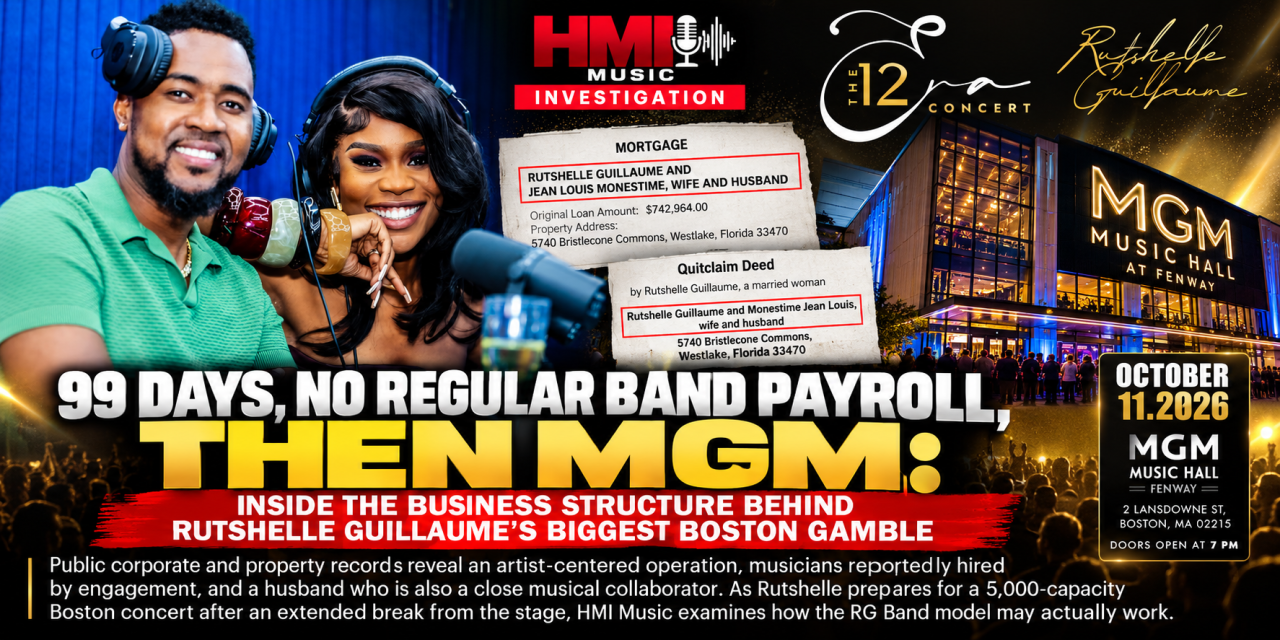
Public corporate and property records reveal an artist-centered operation, musicians reportedly hired by engagement, and a husband who is also a close musical collaborator. As Rutshelle prepares for a 5,000-capacity Boston concert after an extended break from the stage, HMI Music examines how the RG Band model may actually work.
HMI Music — Industry Investigation | September 2026
For most working bands, nearly three months without concerts would sound alarming.
No shows generally means no performance fees. No performance fees can mean no money to divide among musicians. And for a traditional band carrying permanent members, transportation costs, rehearsals, management and other expenses, an extended absence from the stage can become a serious financial problem.
But RG Band may not operate like a traditional Haitian band at all.
That distinction could help explain one of the more interesting questions surrounding Rutshelle Guillaume’s upcoming October 11 concert at MGM Music Hall at Fenway:
How can an artist go months without regular live-performance income and then emerge with an ambitious self-promoted concert at a venue her own website advertises as having a 5,000-person capacity?
The answer may begin with the structure behind the name “RG Band.”
And public records provide some surprising clues.
The July 4 Starting Point
The timeline begins in South Florida.
On July 4, 2026, Rutshelle Guillaume appeared at the Summer Flex event at Hollywood Live. The event had been promoted with Rutshelle, Tonymix and Harmonik.
According to information provided to HMI Music, Harmonik ultimately did not perform following an issue involving Harmonik and RG Band. HMI Music has not independently established the circumstances surrounding that dispute, so we are not assigning responsibility to either side.
What matters for this investigation is what happened afterward.
Based on the performance history HMI Music has been tracking, July 4 appears to have been Rutshelle/RG Band’s last confirmed public performance before the scheduled October 11 MGM concert.
If that timeline remains unchanged, the distance between those two dates is approximately 99 days.
That is more than three months.
Yet Live Nation currently confirms Rutshelle Guillaume for October 11 at 9 p.m. at MGM Music Hall at Fenway, and her own 12 Era concert website advertises the venue as having a 5,000-person capacity.
Apple Music’s current concert page likewise lists MGM as her upcoming concert.
So how does RG Band financially survive the gap?
Perhaps that is the wrong question.
Is RG Band Actually a Traditional Band?
The name “RG Band” naturally suggests a conventional band—a permanent collection of musicians operating together under one name.
But according to information provided to HMI Music about the group’s working arrangements, there is no conventional permanent roster of RG Band members. Musicians are reportedly brought in and compensated on an engagement-by-engagement basis.
HMI Music has not reviewed those musicians’ contracts or payroll records, so we cannot independently establish individual compensation arrangements.
But the public corporate record reveals something significant about the organization’s legal structure.
Florida Division of Corporations records show that RG BAND MUSIC, LLC was formed in March 2022 and remains active. The state currently identifies Rutshelle Guillaume as its manager and registered agent. No other manager is listed on the current corporate record.
That is an important distinction.
Legally, the public corporate record doesn’t present RG Band Music LLC as a company jointly managed by a collection of musicians.
It presents an organization centered on Rutshelle Guillaume.
There is another indication of that structure: a federal trademark application for the name RUTSHELLE GUILLAUME, covering recordings, merchandise and entertainment services including live performances, was filed by RG BAND MUSIC, LLC in April 2025.
Taken together, the records suggest that “RG Band” may be better understood as an artist-centered musical and business operation built around Rutshelle Guillaume, rather than a traditional band whose permanent members collectively constitute the organization.
That difference changes the economics dramatically.
No Concert Doesn’t Necessarily Mean a Band Is Losing Payroll Every Week
Imagine a traditional band with eight permanent musicians.
If those musicians receive salaries, retainers or guaranteed compensation regardless of how many concerts the group performs, going 99 days without engagements could create a substantial financial burden.
But suppose the musicians are independent players paid when they rehearse and/or perform.
The economics become completely different.
There may be no large weekly musician payroll to maintain between concerts.
A musician can play a Rutshelle engagement one weekend and potentially work elsewhere afterward, subject to whatever agreements the musician has.
When another RG Band performance approaches, musicians can be assembled again.
That would make a 99-day performance drought considerably easier for the organization itself to absorb than it would be for a conventional full-time band.
It would also explain how an operation can seemingly go quiet for months and then reactivate for a major production.
But one musician appears to occupy a particularly interesting position in this structure.
The JayKeyz Connection Goes Beyond Music
JayKeyz has been closely associated with Rutshelle musically.
But documents reviewed by HMI Music establish that their relationship extends beyond the stage.
The legal name appearing in the relevant records is Jean Louis Monestime.
The Clark County marriage-search records provided to HMI Music show a September 1, 2024 marriage-license record involving MONESTIME, JEAN LOUIS and GUILLAUME, RUTSHELLE.
By itself, a marriage-license search entry deserves some caution because a license record does not always tell the entire subsequent history of a marriage.
Florida records, however, go substantially further.
“Wife and Husband”
When Rutshelle acquired a newly built home in South Florida, in November 2024, the recorded Special Warranty Deed described her as:
“Rutshelle Guillaume, a married woman.”
The property was transferred from Minto PBLH, LLC.
The mortgage executed in connection with the property is even more explicit.
The document identifies the borrowers as:
“RUTSHELLE GUILLAUME AND JEAN LOUIS MONESTIME, WIFE AND HUSBAND.”
The mortgage documents show an original principal amount of $742,964.
The mortgage identifies the secured property as a property located in South Florida.
Then came another transaction.
In February 2025, Rutshelle executed a quitclaim deed transferring the property from herself individually into the names of Rutshelle Guillaume and Monestime Jean Louis.
Once again, the recorded instrument explicitly describes them as:
“wife and husband.”
This is no longer merely social-media speculation about two musicians who spend considerable time together.
These are recorded Florida real-estate documents.
Why JayKeyz May Be Different From the Other RG Musicians
That personal relationship potentially matters when trying to understand RG Band’s business model—but only up to a point.
If the other musicians are indeed independent performers compensated per engagement, their economic relationship with RG Band can begin and end with particular jobs.
JayKeyz is in a fundamentally different personal position because the public documents identify Jean Louis Monestime and Rutshelle Guillaume as husband and wife.
That does not establish that JayKeyz owns RG Band Music LLC.
It does not establish that he receives a salary.
It does not establish that he shares concert profits.
And it does not establish that he participates in Rutshelle’s business decisions.
In fact, Florida’s current corporate filing identifies Rutshelle alone as the manager of RG Band Music LLC.
But it helps explain why JayKeyz could appear more continuously connected to Rutshelle’s musical operation than musicians hired for individual engagements.
The personal household and the professional musical operation may overlap in ways that simply don’t exist with ordinary hired players.
The exact financial arrangements remain private.
And Then Comes MGM
This is where all these pieces become relevant.
Rutshelle isn’t returning from this extended performance gap with a small club date.
She is scheduled for MGM Music Hall at Fenway in Boston on October 11. Live Nation currently lists only Rutshelle Guillaume in the event’s lineup.
And her own 12 Era promotional website makes the scale of the ambition unmistakable.
It advertises MGM Music Hall as:
“Capacity 5,000.”
That is particularly noteworthy because, based on the Boston performance history HMI Music has been examining, Rutshelle has not previously established a comparable solo-headlining box-office record in Boston.
Her earlier Boston-area appearances have generally involved shared bills, clubs or events featuring other performers.
October 11 is therefore something different.
It is a direct test of Rutshelle Guillaume as the attraction.
And There Is No Boston Promoter to Blame—or Credit
According to information provided to HMI Music about the production, Rutshelle is promoting the MGM concert herself rather than working through a traditional local Haitian promoter in Boston.
The companies supporting the event are described to HMI Music as Rutshelle’s existing business partners rather than independent Boston promoters.
HMI Music has not obtained the MGM venue contract, so we cannot independently determine the precise promoter-of-record, guarantee, rental structure, settlement terms or division of financial risk.
That limitation matters.
Live Nation’s public page confirms the concert, but a ticketing/event listing does not disclose the private economics behind the booking.
So we cannot responsibly say how much Rutshelle personally invested, what MGM requires financially, what her partners contributed, or how many tickets must be sold before the production breaks even.
But if the information about the self-promoted structure is accurate, the business story becomes considerably more interesting.
Rutshelle isn’t merely performing at MGM. She and her organization are making a bet on Rutshelle.
The Ticketmaster Map Adds Another Question
A Ticketmaster screenshot reviewed by HMI Music this week shows availability across the general-admission floor and numerous displayed 200- and 300-level sections.
It also displays a $79 “Dance Floor Limited Special” for general-admission standing room.
That screenshot must be interpreted carefully.
A Ticketmaster map cannot tell us exactly how many tickets have been sold. It doesn’t reveal the original manifest, production holds, unreleased inventory, complimentary tickets or the promoter’s break-even point.
Blue sections mean tickets are being offered in those areas—not that every seat in those sections remains unsold.
Therefore, HMI Music cannot calculate Rutshelle’s ticket sales from the map alone.
But the map gives us something worth monitoring: available inventory and pricing strategy.
And for a self-promoted first major Boston solo test, those two indicators matter.
99 Days May Actually Reveal the Advantage of the RG Model
This brings us back to the original question.
How does RG Band survive approximately 99 days without performing?
If the information HMI Music has received about the musicians being paid by engagement is accurate, the answer may be surprisingly simple:
RG Band may not have to “survive” the way a traditional band does.
There may be no permanent roster requiring continuous band payroll.
The legal business entity is managed by Rutshelle.
Musicians can reportedly be assembled as engagements require them.
JayKeyz occupies a different personal position because public real-estate records identify Jean Louis Monestime and Rutshelle as husband and wife.
That structure potentially allows the organization to dramatically reduce musician expenses when there are no performances and then increase spending when a major production approaches.
It is potentially a leaner artist-business model than maintaining a conventional band year-round.
But MGM presents the opposite side of that advantage.
You Can Save Money Between Shows. You Still Have to Be Ready on Show Night.
A 5,000-capacity production doesn’t assemble itself.
If musicians haven’t been regularly performing together, preparation becomes increasingly important.
Musicians need rehearsals.
Arrangements need to be finalized.
Transitions have to work.
Sound and lighting cues need to be coordinated.
Production personnel need to know the show.
Backline and equipment must be arranged.
Any dancers, backing vocalists or additional musicians have to be integrated.
And a performer attempting an important standalone concert needs the entire operation to feel like a band, regardless of whether the musicians technically operate as permanent members.
That is where the 99-day gap becomes artistically as interesting as it is financially.
Rutshelle may have built a business model capable of remaining lean when there are no concerts.
October 11 will test how effectively that operation can expand again when the stakes become much larger.
Getting MGM and Filling MGM Are Two Different Things
Perhaps the biggest misconception surrounding the concert is that booking MGM itself proves Rutshelle can fill it.
It doesn’t.
Nor would available tickets today prove that she cannot.
The booking demonstrates that Rutshelle’s organization was able and willing to undertake an MGM-scale event.
The audience will determine the rest.
That makes October 11 more than another Rutshelle Guillaume concert.
It is simultaneously a test of her Boston drawing power, her self-promotion strategy, the RG Band operating model and her ability to convert an artist-centered business structure into a large-scale live production.
And perhaps that is the real story behind those 99 days.
RG Band may not be sitting somewhere waiting for the next paycheck.
It may simply be designed to switch on when Rutshelle needs it.
For three months, that model can look remarkably efficient.
At MGM Music Hall, however, efficiency will no longer be enough.
The musicians will have to become a band. The marketing will have to become ticket buyers. And Rutshelle’s decision to bet on herself will finally meet the Boston box office.